What Does a Sales Consultant Do for B2B Companies? A Practical Guide for Founders and Sales Leaders

The Quick Take
If your pipeline is inconsistent, your team is busy but not closing, or founders are still doing too much selling themselves, a sales consultant can help you find the real bottleneck fast. The best consulting work is not theory. It is diagn
If your pipeline is inconsistent, your team is busy but not closing, or founders are still doing too much selling themselves, a sales consultant can help you find the real bottleneck fast. The best consulting work is not theory. It is diagnosis, prioritization, and execution support tied to revenue.
What a sales consultant actually does for a B2B company
A good sales consultant does four things: audits the current system, identifies the highest-leverage fixes, designs the process, and helps the team adopt it. In other words, they do not just "motivate" the team — they improve the mechanics of how revenue is created.
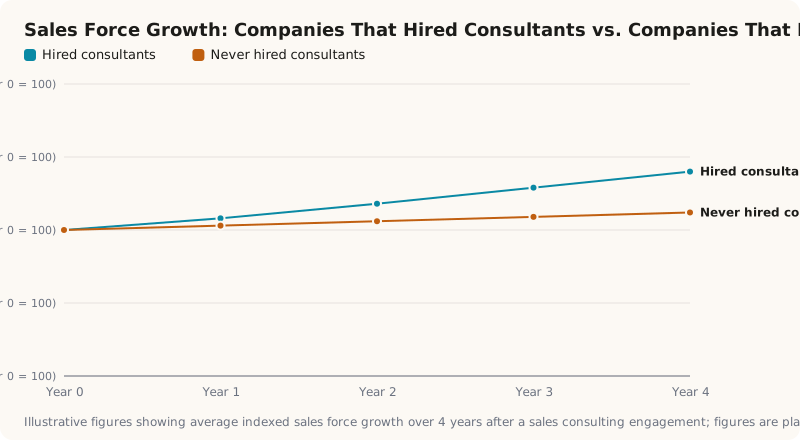 Illustrative figures showing average indexed sales force growth over 4 years after a sales consulting engagement; figures are plausible directional estimates, not a sourced benchmark.
1) Diagnose where revenue is leaking
When people ask what does a sales consultant do for B2B companies, the most accurate answer is: they find the bottleneck. That bottleneck could be any stage in the funnel:
- too few qualified leads
- weak discovery calls
- poor follow-up discipline
- low demo-to-proposal conversion
- pricing objections handled inconsistently
- forecasts based on hope instead of data
A consultant will usually review CRM data, call recordings, pipeline stages, win/loss patterns, outbound messaging, and the handoff between marketing and sales. In many B2B teams, the issue is not one big failure; it is five small failures adding up.
2) Build or repair the sales process
For many firms, the sales process is informal: reps sell differently, managers coach inconsistently, and the CRM reflects activity rather than reality. Sales consulting is often about creating a clear operating system:
- lead source definition
- qualification criteria
- stage-by-stage exit criteria
- follow-up cadence
- proposal and closing standards
- forecast review rules
This is especially valuable in sales process consulting for SaaS companies, where small improvements in qualification, demo structure, and trial-to-close conversion can change the economics of the business.
3) Improve messaging and positioning
Many teams lose deals before the first meeting because their message sounds generic. A consultant helps sharpen the value proposition for the buyer, not the internal team. That means making sure the sales narrative speaks to business outcomes, implementation risk, and measurable ROI.
4) Coach managers to run the system
The consultant’s job is not to become the forever manager. The real goal is to transfer capability to the leadership team so performance becomes repeatable. That often includes training sales managers on deal reviews, pipeline inspection, and performance scorecards.
Sales consulting vs sales coaching vs sales training
These terms are often used interchangeably, but they solve different problems.
Sales consulting vs sales coaching
Sales consulting vs sales coaching comes down to whether the issue is primarily systemic or individual.
- Consulting fixes the system: process, structure, messaging, metrics, and management rhythm.
- Coaching improves the person: mindset, skills, call technique, objection handling, and accountability.
If your team has no clear qualification standard, coaching alone will not solve it. If the process is solid but one rep is underperforming, coaching may be the right lever.
Sales consulting vs sales training
Sales consulting vs sales training is similar, but training is usually event-based while consulting is diagnostic and implementation-led.
- Training transfers knowledge and techniques.
- Consulting figures out what the business needs, designs the fix, and often helps embed it.
For example, a training session may teach discovery questions. A consulting engagement may reveal that your discovery calls are failing because marketing is sending the wrong leads, sales lacks qualification criteria, and managers are not reviewing call quality.
When each one is the right choice
- Choose training if your team needs a skill lift on a known topic.
- Choose coaching if individual performance is inconsistent.
- Choose consulting if the pipeline system itself is broken or unclear.
For many companies, the best answer is a combination: consulting to diagnose and redesign, then coaching and training to execute.
Where sales consulting creates the biggest lift
Sales consulting is not just for enterprises. It can be high impact for startups, SMEs, and specialized industries where one weak process can suppress revenue for months.
B2B sales consulting for startups
B2B sales consulting for startups is often about speed and focus. Early-stage companies need to discover what buyers will actually pay for, which segment converts fastest, and which sales motion is viable.
Typical startup goals include:
- defining an ICP that is narrow enough to win
- building a repeatable outreach message
- setting up a simple pipeline in CRM
- shortening the sales cycle
- identifying the first scalable channel
A startup with three founders and two reps does not need a 90-page sales manual. It needs a working system that turns conversations into revenue.
Sales strategy consulting for SMEs
Sales strategy consulting for SMEs tends to focus on efficiency. SMEs often have decent demand but weak conversion discipline. The common pattern is lots of activity, low predictability, and founder dependency.
A consultant can help the business:
- segment accounts by potential value
- prioritize the right industries and geographies
- standardize proposals and pricing logic
- improve pipeline review cadence
- reduce reliance on the owner for closing
Sales consulting for underperforming sales teams
Sales consulting for underperforming sales teams is usually the highest-urgency use case. Signs include missed targets for multiple quarters, low conversion rates, poor CRM hygiene, and managers unable to explain where deals are stalling.
A practical recovery plan usually includes:
- a 2-week diagnostic
- a stage-by-stage pipeline review
- call audits and message testing
- weekly manager inspection rhythms
- 30/60/90-day performance targets
The goal is to stop guessing and start managing by evidence.
Sales consultant for manufacturing companies
A sales consultant for manufacturing companies often works on long, technical, relationship-driven sales cycles. These teams may need stronger account segmentation, distributor alignment, technical discovery, and proposal discipline.
In manufacturing, the issue is often not lead volume alone. It is the quality of buyer qualification, the ability to navigate multiple stakeholders, and the consistency of follow-up across a long sales cycle.
Sales consulting for small businesses
Sales consulting services for small businesses are usually valuable when the company has enough demand to grow but not enough structure to scale. A small business does not need enterprise complexity. It needs a simple, enforceable playbook that helps each rep do the right thing every day.
A practical framework for choosing the right consultant
If you are asking how to choose a sales consultant, start with problem definition, not vendor popularity. The best consultant for your business is the one whose method matches your bottleneck.
Step 1: Name the problem in numbers
Before you talk to any consultant, define the gap. Examples:
- lead-to-meeting conversion is 8% and should be 15%
- proposal-to-close is 22% and should be 30%+
- average deal cycle is 94 days and needs to drop below 70
- 60% of reps are below quota for three quarters in a row
Specific numbers force clarity.
Step 2: Ask for a diagnosis approach
A credible consultant should explain how they assess the business. Look for a process that includes:
- CRM and pipeline review
- stakeholder interviews
- call and email analysis
- win/loss review
- management rhythm assessment
If someone starts with a generic promise of “more sales” before understanding the business, that is a warning sign.
Step 3: Evaluate relevant experience
Industry experience matters when the sales cycle is technical, regulated, or channel-heavy. For example, a consultant who understands SaaS may be very effective in sales process consulting for SaaS companies, while a consultant with industrial background may be better suited as a sales consultant for manufacturing companies.
Step 4: Check for implementation support
The best consultants do not hand over slides and disappear. They help the team implement, whether through working sessions, manager enablement, scorecards, or reinforcement over several weeks.
Step 5: Expect a commercial outcome
Good consulting should improve one or more measurable outcomes:
- higher conversion rates
- shorter sales cycles
- better lead quality
- stronger forecast accuracy
- higher rep productivity
If the offer is vague, the outcome will be vague.
Cost, location, and buying signals: what businesses should expect
One of the most common questions is how much does sales consulting cost. The honest answer is: it depends on scope, company size, and whether the work is diagnostic only or includes implementation.
Typical pricing logic
Most engagements are priced in one of three ways:
- project-based for audits and strategy work
- monthly retainer for ongoing advisory and implementation
- workshop plus follow-up for focused team interventions
For small and mid-sized B2B firms, the cost often ranges from a few thousand dollars for a targeted project to significantly more for multi-month transformation work. The right question is not “What is the cheapest option?” but “What revenue problem will this solve, and what is that worth?”
Geography should not limit your options
Companies often search for sales consulting services in UAE or sales consulting services in Pakistan because they want local context, time-zone alignment, and market understanding. Those matter, especially when buyer behavior, hiring norms, and business culture affect sales execution.
At the same time, many B2B firms work with consultants across borders if the methodology is strong and the engagement is structured well. The key is fit, not location alone.
Signs you need consulting now
You likely need a consultant if:
- the founder is still closing most of the deals
- reps are active but pipeline is weak
- lead generation is inconsistent
- CRM data cannot support a forecast
- managers cannot explain why deals are lost
- every quarter starts with a new sales “push” instead of a system
If the main problem is lead flow, you may also need a sales consulting firm for lead generation improvement that can align messaging, targeting, and conversion handoffs.
From diagnosis to action: what a strong first engagement should deliver
The best first step is not a long transformation program. It is a focused diagnostic that shows exactly where the revenue gap sits and what to fix first.
A strong engagement should leave you with:
- a clear diagnosis of the biggest bottleneck
- a prioritized action plan
- process changes the team can actually use
- manager scorecards and review rhythms
- a 30/60/90-day execution roadmap
That is the point where consulting becomes operational, not theoretical.
If you are evaluating sales consulting services for small businesses, B2B sales consulting for startups, or broader sales strategy consulting for SMEs, start with a diagnostic that tests your assumptions against the data. If your team is underperforming, if your pipeline is unpredictable, or if you are not sure whether the real issue is process, skill, or leadership rhythm, a Training Needs Assessment is the fastest way to find out.
Sales Bullseye works with founders, CEOs, and revenue leaders who want a practical answer to what is broken and what to fix first. If that is where you are, book a Training Needs Assessment with Sales Bullseye and get a clear, evidence-based roadmap for improving sales performance.
Ready to Audit Your Pipeline?
Get a high-level Training Needs Assessment for your sales organization.
About Nabeel Khalid
Nabeel is the founder of Sales Bullseye. He has trained hundreds of B2B sales professionals across Pakistan and the United States in the Bullseye Method — a high-integrity, methodology-led approach to complex deal closure built on retention, not one-off workshops.