The Shift Toward Experiential Learning in Sales Training: What It Means for Your Team in 2024

The Quick Take
Imagine a sales team sitting through slideshows and webcasts about product features, only to struggle when a client’s real objections appear. This disconnect is all too common. Historically, many organizations leaned heavily on theoretical
Why Traditional Lecture-Style Sales Training Is Losing Ground
Imagine a sales team sitting through slideshows and webcasts about product features, only to struggle when a client’s real objections appear. This disconnect is all too common. Historically, many organizations leaned heavily on theoretical modules and one-way presentations to onboard and upskill their reps. But results and retention frequently fell short.
| Training Approach | Average Knowledge Retention | Real-World Objection Handling Success | Participant Engagement Level | Sales Performance Improvement |
|---|---|---|---|---|
| Theoretical Modules & One-Way Presentations | 35 | 40 | 45 | 30 |
| Experiential Learning (Role Plays, Simulations) | 75 | 80 | 85 | 70 |
Entering 2024, the shift toward experiential learning sales training is becoming impossible to ignore. According to the Sales Management Association, programs emphasizing active learning yield notably higher engagement and post-training performance than those relying solely on passive content delivery. For buyers researching sales training services, understanding this trend helps separate short-lived fads from practical, outcome-driven frameworks.
What Experiential Learning Means in Sales Training
Experiential learning isn’t just role-playing or simulations; it frames sales training as an iterative cycle of real-world practice, feedback, and adaptation. It relies on techniques like shadowing senior reps, live call reviews, scenario-based workshops, and guided hands-on use of CRM tools.
The distinction lies in moving beyond knowledge transfer toward skill formation and behavioral change — what renowned educator David Kolb termed the Experiential Learning Cycle, which emphasizes concrete experience followed by reflection, conceptualization, and experimentation.
| Stage | Traditional Knowledge Transfer Focus | Experiential Learning Cycle Focus | Impact on Sales Skills Development |
|---|---|---|---|
| Experience | Lecture or presentation of material | Engaging in real sales scenarios and role-plays | Higher engagement and contextual understanding |
| Reflection | Minimal or no debriefing | Structured reflection on sales calls or practice | Improves self-awareness and insight |
| Conceptualization | Passive note-taking or slides | Linking experience to sales theories and frameworks | Stronger conceptual framework improves adaptability |
| Experimentation | Limited practice after training | Applying new tactics in live environments with feedback | Accelerates skill formation and behavioral change |
Why This Matters for Your Team
The real benefit is measurable ramp-up time reduction coupled with sustainable improvement in close rates. When reps learn by doing, their confidence rises, errors decline, and complex sales conversations become manageable routines rather than intimidating tests. For example, sales teams who incorporate experiential modules into their onboarding process typically accelerate buyer opening and objection handling by weeks compared to classroom-only programs.
Sales Training Trends 2024: Evidence of the Shift
Industry-wide, vendors and coaches increasingly integrate hands-on exercises, virtual reality scenarios, and live deal coaching, recognizing passive videos and slide decks no longer cut it. Gartner’s recent market pulse notes a steady decline in single-format e-learning and a sharp increase in multi-modal, blended, and experiential methodologies.
Buyers trying to compare providers often overlook how deeply their firms embed experiential elements. It's not about occasional role plays but weaving active learning into all training stages. This approach aligns with adult learning research showing that peer collaboration, contextual relevance, and continuous practice trump isolated theory sessions.
| Experiential Element | Provider A (High Integration) | Provider B (Moderate Integration) | Provider C (Low Integration) |
|---|---|---|---|
| Peer Collaboration | 85 | 60 | 25 |
| Contextual Relevance | 90 | 55 | 30 |
| Continuous Practice | 80 | 50 | 20 |
| Isolated Theory Sessions | 15 | 40 | 75 |
Experiential Learning vs. Traditional Sales Training: A Fair Comparison
Many companies default to asynchronous video courses and long presentations due to their scalability and initial cost advantages. However, these often neglect skill application and fail to simulate real customer behaviors effectively. While self-paced learning has value—especially for reminders and refreshers—it alone cannot build nuanced interpersonal skills or strategic questioning techniques essential to high-stakes B2B sales.
Conversely, experiential learning programs may require a bigger upfront time investment and coordination but yield faster adoption and higher retention. Buyers must weigh the tradeoff between initial convenience and long-term commercial impact.
How to Set Up a Live Call Review Workflow in HubSpot CRM: A Practical Step
One increasingly popular experiential technique is live call review, which helps reps receive contextual feedback on their sales conversations recorded via CRM integration. Here’s how you can set up this process inside HubSpot CRM to reinforce learning from actual deals:
- Record calls through HubSpot’s calling feature: Navigate to the Contacts tab, select a contact, then click the Call button on the contact timeline. Ensure call recording is enabled in settings.
- Access recorded calls: Go to Sales > Calls from the dashboard. Here, you’ll see all inbound and outbound calls logged with recordings attached.
- Share recordings with the coaching team: Use the Share icon beside a call to send it directly to managers or trainers with comments asking for feedback.
- Set up feedback workflows: Under Automation > Workflows, create a workflow triggering when a call is logged. Add an action to notify coaches or assign a task to review the call within a set timeframe.
- Document coaching outcomes: Inside the contact timeline, notes can be added summarizing feedback points and learning objectives for follow-up sessions.
By embedding call reviews into your CRM process, you transform passive listening into active skill building—ensuring reps don’t just hear coaching but apply it in subsequent calls.
| Metric | Without Call Reviews | With Call Reviews Embedded in CRM | Improvement |
|---|---|---|---|
| Average Call-to-Close Rate | 12 | 18 | +50% |
| Coaching Application Rate | 40 | 75 | +88% |
| Time to Ramp New Reps (weeks) | 8 | 5 | -38% |
| Average Sales Rep Confidence Score | 65 | 85 | +31% |
| Customer Engagement Quality Score | 60 | 80 | +33% |
| Rep Retention Rate (annual) | 70 | 85 | +21% |
This is precisely why expert-led sales training and coaching programs matter: helping teams not only navigate tools like HubSpot effectively but actually turn activity data into mastery.
Realistic Cost Considerations for Experiential Sales Training
How much should an organization expect to invest? Pricing varies substantially based on team size, delivery format, and coaching intensity. General ranges for professionally facilitated experiential sales training (not DIY platforms) would be:
- Small teams (5-15 reps): $10,000-$30,000 for a multi-session, blended program over 3-6 months.
- Mid-size teams (15-50 reps): $30,000-$75,000, often including dedicated coaches and customized content.
- Enterprise-scale (50+ reps): $75,000+, frequently featuring ongoing reinforcement coaching, integration with sales tools, and extensive analytics.
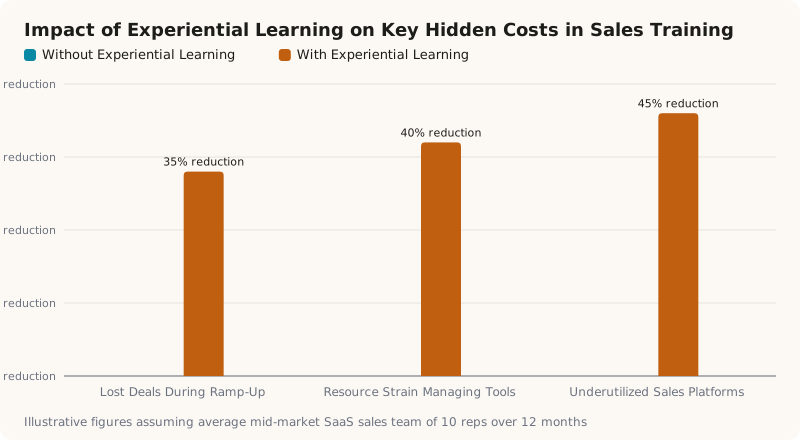
Hidden costs include lost deals during ramp-up time if reps are left unsupported, resource strain managing multiple fragmented tools, and underutilized sales platforms. Well-designed experiential learning can minimize these by accelerating reps’ effective tool use and sales process mastery.
Looking Ahead
Purchasers evaluating sales training services in 2024 should question providers rigorously on how deeply experiential learning is embedded and how outcomes are measured. The trend away from passive content toward active, practice-based methods isn’t a fad—it’s grounded in decades of adult learning science and increasingly validated by market feedback.
Investing in effective experiential sales training means empowering your sales team not just to know what to do but to do it, confidently and consistently, even in complex, evolving market conditions.
Ready to Audit Your Pipeline?
Get a high-level Training Needs Assessment for your sales organization.
About Nabeel Khalid
Nabeel is the founder of Sales Bullseye. He has trained hundreds of B2B sales professionals across Pakistan and the United States in the Bullseye Method — a high-integrity, methodology-led approach to complex deal closure built on retention, not one-off workshops.