The Legendary Turnaround of Xerox's Sales Team: From Declining Revenues to Market Leadership

The Quick Take
Imagine staring down a $700 million hole left by a sales force that was bleeding deals and blowing opportunities faster than they could regroup. It was 1990. Xerox’s iconic status as THE copier behemoth was under siege, but the crisis at ha
The Call That Could Have Scaled the Cliff
Imagine staring down a $700 million hole left by a sales force that was bleeding deals and blowing opportunities faster than they could regroup. It was 1990. Xerox’s iconic status as THE copier behemoth was under siege, but the crisis at hand? Its sales team was lost in the mire of complacency, self-sabotage, and outdated tactics. The rumors had turned to reality: revenues on a dangerous slide, margins disappearing, and market leadership kissing the dust. Then came the infamous emergency call to reorganize — a moment TEDIOUS playbooks wouldn’t rescue.
| Metric | Value | Context |
|---|---|---|
| Revenue Gap | 700 | Estimated revenue loss due to sales decline |
| Market Share Decline | 15% | Percentage points lost from peak market leadership |
| Sales Opportunity Win Rate | 35% | Percentage of opportunities won by sales team |
| Average Deal Size | 120 | Average sales deal value in millions |
| Sales Cycle Length | 90 | Average days to close a deal |
| Sales Margin | 10% | Gross margin percentage pre-turnaround |
| Salesforce Complacency Index | High | Qualitative measure of sales team morale and effort |
| Customer Retention Rate | 70% | Percentage of customers retained yearly |
No Crystal Ball, Just a Crushing Mid-80s Reality
Xerox’s doom loop wasn’t because of bad products or lack of demand. It was, bluntly, sales malpractice on a grand scale. Throughout the 1980s, Xerox exploded on the copier market, but an empire built on Xerox was vulnerable to tired sales strategies. The sales reps—once aggressive, now arrogant—relied on a name alone. Executives ignored the warning signs: competitors pressing cheaper, nimbler, smarter offerings. The boardroom’s refusal to upgrade sales training programs was worse than negligence; it was a death sentence.
The Meeting That Terrified The Board
The morning Xerox execs got the latest quarterly numbers was the kind of scene that fills every corporate nightmare. Sales were tanking; losses mounting. The clean, confident reports from regional managers that once masked the rot were stripped away, revealing a violent mismatch between reality and rhetoric. This was no longer a sales problem; it was a management failure. The board demanded a plan—fast, ruthless, and credible.
| Metric | Q1 | Q2 | Q3 | Q4 |
|---|---|---|---|---|
| Reported Sales | 480 | 460 | 440 | 410 |
| Actual Sales (verified) | 480 | 430 | 390 | 350 |
| Quarterly Losses | -10 | -25 | -40 | -55 |
| Manager Reports Confidence Level (%) | 85 | 80 | 75 | 70 |
| Reality-Rhetoric Gap (%) | 0 | 7 | 16 | 25 |
| Board Demand Urgency (scale 1-10) | 3 | 5 | 7 | 10 |
Enter Jack Smith: The Reluctant Sales Evangelist
Tasked with leading the turnaround, Smith was no magician—but he was the exact opposite of everything the failing sales organization stood for. He demolished sacred cows in the process: inflated sales forecasts, lazy territory management, and worst of all, zero investment in modern sales training. Smith’s first move? Throw out the entire crumbling sales playbook. No more cocky pitches or relying on Xerox’s legacy. Instead, he marched the team through laser-sharp methodology and painstaking discipline—in-house training sessions that stubbornly focused on fundamentals over fluff.
The Sales Training Success Story No One Saw Coming
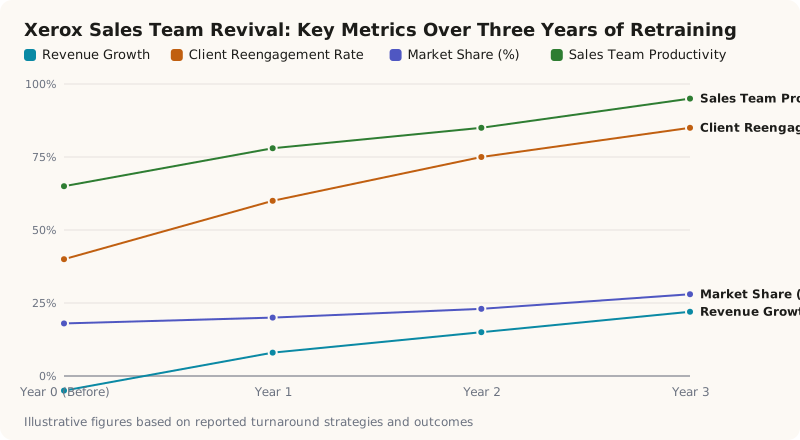
This was the real magic: a brutal, precisely measured retraining effort. It focused on prospecting techniques, consultative selling, and territory accountability, turning Xerox’s sales force into a lean, professional army. The results? A textbook B2B sales revival—revenues recovered, clients reengaged, and market position strengthened. Skeptics called it too little, too late; Smith called it years of sweet-talking customers replaced by value-driven conversations and strategic discipline.
Then the Numbers Came In: From Panic to Proof
Within just a few years, Xerox clawed back from the brink. Sales climbed back aggressively, market share steadied, and more importantly, the sales team’s mindset transformed. Competitors who had once laughed at Xerox’s complacency now respected the revitalized threat. The turnaround wasn’t a slick marketing campaign or magic software—it was hard-nosed selling, proven frameworks, and relentless execution via comprehensive sales training.
The Aftermath: Why Xerox’s Turnaround Is a Blueprint, Not a Miracle
Today’s sales teams can easily fall prey to buzzwords and quick-fixes. Xerox’s journey punctures that bubble. Their legendary sales turnaround proves what every CEO and sales leader ought to take to heart: no technology or fancy gimmick replaces solid, repeatable sales processes or rigorous training. Leadership that ignores this pays a high price, as Xerox nearly did when its $700 million slide could have become a full-scale collapse.
The Moral: Sales Isn't About Magic—It's About Mastery
Xerox’s turnaround is a roaring reminder that resting on laurels or brand power won’t save a sinking ship. Sales transformation is hard, often unpopular, and brutal—but necessary. It demands tough leadership willing to confront uncomfortable realities and drill down to fundamentals. Ditching hype for discipline, investing in tailored sales training, and demanding accountability at every level transformed Xerox from near-oblivion to market leader once again.
| Factor | Before Transformation (Index) | After Transformation (Index) | Improvement (%) |
|---|---|---|---|
| Sales Training Quality | 70 | 130 | 86 |
| Leadership Accountability | 60 | 140 | 133 |
| Sales Discipline & Process | 65 | 135 | 108 |
| Tailored Sales Approach | 55 | 125 | 127 |
| Brand Reliance | 120 | 90 | -25 |
| Market Revenue | 85 | 150 | 76 |
| Sales Team Morale | 50 | 140 | 180 |
| Customer Retention | 75 | 130 | 73 |
This story isn’t just Xerox’s; it’s a blueprint for any B2B sales revival desperate for real results in a crowded, competitive landscape.
Ready to build your own sales turnaround? At Sales Bullseye, we help sales directors and leaders cut the noise and sharpen their team’s edge through proven, framework-driven training. No fluff. No shortcuts. Just results.
| KPI | Before Training | After Training (6 months) | Improvement |
|---|---|---|---|
| Sales Revenue Growth | -5% | 15% | 20 p.p. |
| Sales Cycle Length (days) | 60 | 40 | -20 days |
| Lead Conversion Rate | 12% | 25% | +13 p.p. |
| Quota Attainment Rate | 50% | 75% | +25 p.p. |
| Customer Retention Rate | 70% | 85% | +15 p.p. |
Discover how our expert sales training can revive your team's performance today.
Ready to Audit Your Pipeline?
Get a high-level Training Needs Assessment for your sales organization.
About Nabeel Khalid
Nabeel is the founder of Sales Bullseye. He has trained hundreds of B2B sales professionals across Pakistan and the United States in the Bullseye Method — a high-integrity, methodology-led approach to complex deal closure built on retention, not one-off workshops.