Sales Team vs SEO: Where B2B Revenue Really Comes From

The Quick Take
SEO can bring strangers to your website. A strong sales team turns the right strangers into revenue. That difference matters more in B2B than almost anywhere else. Too many companies treat SEO as if ranking higher automatically means sellin
SEO can bring strangers to your website. A strong sales team turns the right strangers into revenue.
That difference matters more in B2B than almost anywhere else. Too many companies treat SEO as if ranking higher automatically means selling more. It does not. Search visibility creates opportunity; sales execution creates outcomes.
If you lead revenue, the real question is not “Should we invest in SEO or sales?” It is “How should these two functions work together so pipeline quality improves, conversion rates rise, and sales time is spent on deals worth winning?”
SEO and Sales Solve Different Problems
SEO is a demand capture and demand creation channel. Sales is a demand conversion function. When teams confuse the two, they usually underinvest in one and overexpect from the other.
What SEO actually does
SEO helps your company show up when buyers search for:
- a problem they need to solve
- a category they are researching
- a vendor they are comparing
- a specific question they need answered
For example, if a buyer searches:
- “best B2B sales training company”
- “how to improve outbound conversion rate”
- “sales coaching for SaaS teams”
and your content appears, you have earned attention before a sales conversation starts.
But attention is not intent to buy. A visitor may be:
- a student researching the industry
- a competitor
- a founder looking for ideas
- a buyer six months from making a decision
- a ready-to-buy prospect
SEO cannot tell you which one you have until the person takes a next step.
What sales actually does
Sales qualifies, diagnoses, and advances opportunity. In a B2B sale, the rep must uncover:
- business pain
- urgency
- decision process
- stakeholders
- budget reality
- consequences of doing nothing
That work cannot be automated by ranking pages alone. A search result may get you into the room; a good sales conversation gets you into the deal.
The practical takeaway
If SEO is working, your site should receive more relevant traffic. If sales is working, your team should convert more of that traffic into meetings and opportunities. The objective is not to choose one. The objective is to make sure each function does the job it is best suited for.
The Sales Team vs SEO Debate Is Usually a Budgeting Problem
When companies ask whether to invest in sales or SEO, they are usually asking a deeper question: “Where will we get faster revenue?”
That is a fair question. But it needs a framework.
Use the 3-horizon revenue model
Think about growth in three horizons:
- Immediate revenue — next 30 to 90 days
- Mid-term pipeline — next 3 to 9 months
- Long-term compounding — next 9 to 24 months
SEO is strongest in the third horizon and often useful in the second. Sales is strongest in the first and second. If a company needs revenue now, it cannot rely on organic search alone. If a company ignores SEO, it eventually pays a tax in paid acquisition and outbound dependence.
Example: a 12-person B2B services firm
Suppose a professional services company needs $1.2M in annual new business.
A simple model might look like this:
- Average deal size: $40,000
- New deals needed: 30 per year
- Close rate from qualified opportunities: 25%
- Qualified opportunities needed: 120
- Meetings required: 240 if half of meetings become qualified opportunities
Now ask where those 240 meetings come from.
- SEO might contribute 20–40 meetings over time if the site ranks for problem-aware and solution-aware terms.
- Outbound sales might contribute 120–160 meetings if the team is trained, disciplined, and targeting the right accounts.
- Referrals, partners, and events fill the rest.
SEO alone does not typically produce enough immediate volume. Sales alone often becomes expensive and inefficient without inbound support. Revenue stability comes from a mix.
The hidden cost of overvaluing SEO
If a company believes SEO is a substitute for sales capability, several things happen:
- traffic increases, but conversion stays flat
- marketing celebrates impressions while revenue stalls
- SDRs waste time on unqualified inbound leads
- the pipeline fills with low-intent inquiries
This is why many “high traffic, low revenue” companies are not marketing problems. They are conversion problems.
What a High-Performing Sales Team Does That SEO Cannot
SEO can attract attention, but it cannot replace commercial discipline. A trained team makes the difference between curiosity and commitment.
1) It diagnoses the real problem
Buyers often describe symptoms, not causes. A prospect may say:
- “We need more leads.”
- “Our close rate is down.”
- “We want better marketing.”
A skilled rep asks questions that reveal the actual constraint:
- Is the issue lead quality, follow-up, positioning, or sales skill?
- Is the team lacking pipeline, or is it losing opportunities late?
- Is the buyer comparing you to a cheaper alternative or a safer one?
SEO content can support this education, but only sales can clarify the specific business case in real time.
2) It creates urgency
Many B2B buyers are not in a hurry. They are interested, not committed.
Good salespeople quantify the cost of delay:
- missed revenue targets
- wasted rep capacity
- longer sales cycles
- higher CAC
- lower win rates against better-prepared competitors
If a problem costs $15,000 per month and the solution costs $60,000 per year, the economics become obvious. Search traffic does not create this urgency on its own.
3) It navigates stakeholders
SEO rarely tells you who signs the contract, who blocks it, and who influences it. Sales must map the buying committee.
In many B2B deals, you need to win:
- the user who wants the solution
- the manager who approves it
- the finance stakeholder who checks ROI
- the executive who owns the outcome
A rep who can uncover these dynamics will outperform a company that merely generates more website visits.
4) It handles objections live
Objections are rarely resolved by reading another blog post.
A rep has to respond to:
- “We are already working with someone.”
- “Send me more information.”
- “We do not have budget.”
- “We need to think about it.”
This is where training matters. The right message, delivered with the wrong commercial process, still loses deals.
What SEO Does Best for Sales
If sales is the closer, SEO is the amplifier. Good SEO makes sales conversations easier, faster, and more credible.
1) It pre-educates the buyer
By the time a buyer books a call, they may already understand:
- the problem
- the category
- basic options
- your point of view
That means your sales team can spend less time explaining fundamentals and more time assessing fit.
For example, a prospect who has read a strong article on outbound conversion benchmarks may arrive with better questions and higher intent than a cold lead from a generic contact form.
2) It improves trust
Buyers check your website before responding, especially in B2B.
If they find:
- useful articles
- clear positioning
- relevant case studies
- evidence of expertise
then your sales team starts with credibility, not skepticism.
3) It increases self-selection
SEO helps the right buyers opt in and the wrong buyers opt out.
A well-built content system should repel poor-fit traffic by being specific. That is a good thing. If your pages attract everyone, they are probably persuasive to no one.
4) It gives sales better language
The best sales teams borrow language from search behavior and content performance.
If prospects repeatedly search for:
- “sales training for SaaS startups”
- “improve discovery calls”
- “sales coaching for managers”
then your sales team should be using the same language in calls, emails, and proposals. SEO reveals how the market thinks. Sales should use that intelligence.
How to Align SEO and Sales Without Creating Silos
The biggest mistake is letting marketing and sales operate with separate definitions of quality.
Build one funnel with shared metrics
Use shared definitions for:
- a qualified inbound lead
- a sales accepted lead
- a booked meeting
- a sales qualified opportunity
- a closed-won deal
If marketing celebrates form fills and sales cares about close rate, you have a system problem.
Track these numbers together
At minimum, review:
- organic traffic by intent level
- conversion rate from visit to lead
- lead-to-meeting rate
- meeting-to-opportunity rate
- opportunity-to-win rate
- average deal size by source
A channel with less traffic can outperform a high-traffic channel if the downstream conversion is stronger.
Use a content-to-conversation map
For each major topic, define:
- the search intent
- the pain point behind the search
- the sales questions that should follow
- the objection the content should pre-handle
Example:
Topic: outbound sales training
- Search intent: improve outbound performance
- Pain point: low response rates and weak discovery
- Sales questions: What are your current reply and meeting rates? How targeted is your list? Are reps using one message for all accounts?
- Objection to pre-handle: “We already have SDRs”
When SEO and sales share this map, content becomes a sales asset instead of a marketing trophy.
Create a simple SLA between teams
A service-level agreement between marketing and sales should answer:
- What counts as a good inbound lead?
- How quickly should sales respond?
- What feedback does sales provide on lead quality?
- Which topics are producing meetings, not just clicks?
Even a five-point SLA can improve pipeline quality within a quarter.
When to Invest More in Sales, More in SEO, or Both
The right answer depends on your current constraints.
Invest more in sales when:
- your website gets traffic, but conversions are weak
- inbound leads are plentiful, but meetings are not
- deals stall because reps cannot diagnose or close
- you need revenue in the next 90 days
- your team lacks a repeatable sales process
In this case, training, coaching, call review, and pipeline discipline usually produce faster gains than content production.
Invest more in SEO when:
- your sales team is already strong, but pipeline is expensive to source
- outbound is saturated and paid media costs are rising
- buyers research heavily before speaking to vendors
- you have proof points, case studies, and expertise that can rank
- you are willing to wait for compounding returns
SEO becomes more powerful when the company can convert the traffic it earns.
Invest in both when:
- you want a scalable revenue engine
- your market has long consideration cycles
- buyers compare multiple vendors before speaking to sales
- your team needs both inbound credibility and outbound efficiency
Most B2B companies fall into this third category. They do not need a debate. They need a sequence.
The Revenue Sequence That Works
A practical model looks like this:
- Define the ideal buyer and strongest pain points
- Build SEO content around those pain points and buying questions
- Train sales to qualify, diagnose, and convert the resulting inbound interest
- Review calls and conversion data weekly
- Refine content based on the objections and language heard in sales conversations
This creates a loop:
- SEO brings the right audience
- sales discovers what that audience really needs
- content gets sharper
- conversion improves
- revenue becomes more predictable
That is a better system than arguing whether “sales team vs SEO” should win.
Start with the Constraint, Not the Channel
If pipeline is weak, do not ask which channel is more fashionable. Ask where the bottleneck is.
- If the problem is awareness, SEO helps.
- If the problem is conversion, sales helps.
- If the problem is both, you need coordination.
At Sales Bullseye, we usually find that companies have one of two issues:
- they are generating interest but not converting it
- or they are pushing sales hard without a message that makes selling easier
That is exactly why a Training Needs Assessment is useful. It identifies where revenue is leaking: lead quality, rep performance, qualification discipline, messaging, or pipeline management. Once you know the constraint, you can fix the right thing instead of spending six months on the wrong lever.
If your SEO is bringing traffic but your sales team is not turning it into qualified opportunities, the next step is not more content. It is a clearer revenue diagnosis.
Book a Training Needs Assessment with Sales Bullseye, and we will help you determine whether the fastest path to growth is sales training, sales process improvement, better SEO-sales alignment, or all three.
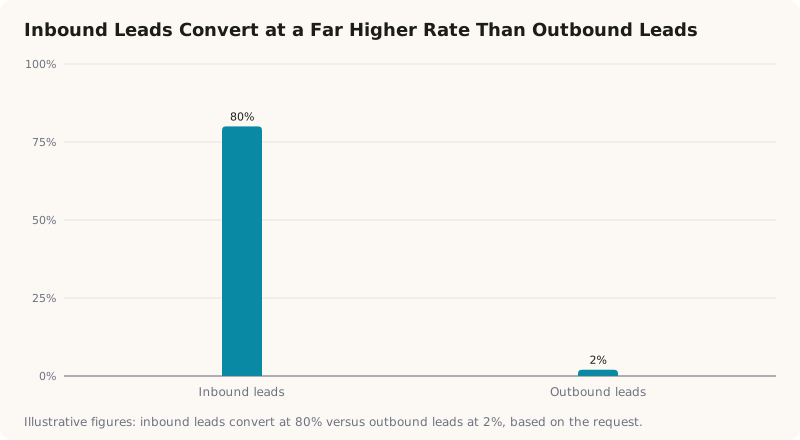 Illustrative figures: inbound leads convert at 80% versus outbound leads at 2%, based on the request.
Ready to Audit Your Pipeline?
Get a high-level Training Needs Assessment for your sales organization.
About Nabeel Khalid
Nabeel is the founder of Sales Bullseye. He has trained hundreds of B2B sales professionals across Pakistan and the United States in the Bullseye Method — a high-integrity, methodology-led approach to complex deal closure built on retention, not one-off workshops.