Sales Coaching: What the Research Says About Performance, Consistency, and Manager Impact

The Quick Take
For many companies, sales coaching used to mean an occasional ride-along, a few words after a lost deal, or a quarterly review of numbers. Today, that approach is looking increasingly outdated. As sales cycles become more complex, buyers mo
Sales Coaching Is Becoming a Core Growth Lever
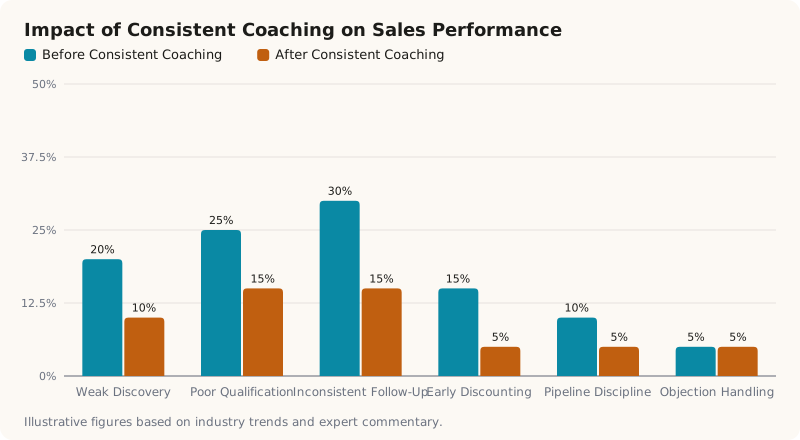 Illustrative figures based on industry trends and expert commentary.
For many companies, sales coaching used to mean an occasional ride-along, a few words after a lost deal, or a quarterly review of numbers. Today, that approach is looking increasingly outdated. As sales cycles become more complex, buyers more informed, and competition more crowded, organizations are paying closer attention to the role of coaching in improving day-to-day performance.
Across the sales industry, one pattern shows up consistently: teams do better when managers coach consistently rather than only inspect results. That shift matters because most revenue problems are not caused by one big failure. They are usually the result of small execution gaps repeated across many opportunities—weak discovery, poor qualification, inconsistent follow-up, or a tendency to discount too early. Coaching is one of the few disciplines that can address those gaps at the source.
What Recent Industry Thinking Suggests
While exact benchmarks vary by company and market, general industry knowledge points to a clear conclusion: frontline managers have a large influence on sales performance, but many are promoted for being strong sellers rather than strong coaches. That creates a common mismatch. A rep may need help with pipeline discipline or objection handling, but the manager spends most of the week in forecasting meetings, CRM review, and deal escalation.
Recent commentary across sales leadership and enablement circles has also emphasized that buyers expect more consultative conversations. That makes sales team development less about scripting every pitch and more about building core selling capabilities: discovery, business acumen, deal strategy, and next-step discipline. In other words, coaching is not just motivational. It is operational.
Another trend is the growing connection between coaching and sales enablement. Companies are realizing that training alone does not change behavior if managers do not reinforce it. Training introduces the framework. Coaching makes it stick. Without that second layer, even good programs fade quickly under pressure from quotas and time constraints.
Practical tools and software that can improve coaching quality
Teams that want better sales coaching often benefit from a simple tool stack:
- Conversation intelligence platforms — review calls, identify patterns, and coach from real examples. Examples: Gong, Chorus by ZoomInfo, Avoma.
- CRM systems — connect coaching to pipeline stages, conversion rates, and forecast data. Examples: Salesforce, HubSpot, Pipedrive.
- Scorecard templates — keep coaching focused on observable behaviors. Examples: Google Sheets, Airtable, Notion templates.
- Enablement libraries — centralize messaging, playbooks, and objection handling guidance. Examples: Highspot, Seismic, Showpad.
- Task and accountability tools — track follow-up actions from coaching sessions. Examples: Asana, Monday.com, Trello.
Why Coaching Delivers Concrete Business Value
The practical benefit of sales coaching is consistency. A team with a strong coaching culture tends to show less variation in execution across reps and managers. That matters because revenue organizations are often not short on talent; they are short on repeatability.
Good coaching can improve several outcomes at once:
- Better pipeline quality: Reps learn to qualify more carefully and avoid filling the funnel with low-probability opportunities.
- Stronger win rates: Managers help reps identify gaps in discovery, value messaging, and deal control before opportunities stall.
- Higher rep confidence: Reps who receive specific feedback are more likely to adapt their approach and stay engaged.
- More effective sales leadership: Managers spend less time rescuing deals and more time developing people.
In many organizations, the biggest payoff is not immediate revenue growth but improved managerial leverage. A good coach multiplies the effectiveness of the entire team. That is why sales coaching is often discussed alongside sales management maturity: it changes the manager from a deal firefighter into a performance builder.
A Practical Tip: Coach One Behavior, Not the Whole Call
If you are evaluating how to improve coaching in your organization, start smaller than most teams expect. Instead of giving broad feedback like “You need to be more consultative,” focus on one observable behavior per coaching conversation.
For example:
- Did the rep ask enough high-quality discovery questions?
- Did they tie pain points to business impact?
- Did they confirm next steps clearly?
- Did they handle pricing pressure with structure instead of defensiveness?
This approach works because it turns coaching from vague critique into repeatable skill building. It also makes manager time more efficient. A rep can only absorb so much at once, and a coach can only reinforce so many priorities before the message becomes unclear.
For leaders building a more disciplined sales performance system, the best place to begin is often with coaching cadence. Short, consistent conversations tied to live opportunities usually outperform occasional long reviews. Pair that with simple call observation, deal review, and one measurable behavior to improve each week.
The Bottom Line
Sales coaching is not a soft extra. It is one of the most practical ways to improve execution in a complex selling environment. The broader industry trend is clear: companies that treat coaching as part of everyday sales leadership, rather than as a side activity, are better positioned to build stronger habits, better managers, and more reliable performance.
If you are researching whether coaching is worth the investment, the question is not whether teams need more information. In most cases, they do not. The real question is whether your managers are equipped to turn knowledge into consistent behavior. That is where effective coaching earns its place.
Ready to Audit Your Pipeline?
Get a high-level Training Needs Assessment for your sales organization.
About Nabeel Khalid
Nabeel is the founder of Sales Bullseye. He has trained hundreds of B2B sales professionals across Pakistan and the United States in the Bullseye Method — a high-integrity, methodology-led approach to complex deal closure built on retention, not one-off workshops.