Objection Handling in Sales: The Skill That Separates Average Reps from Top Performers

The Quick Take
Objections are not the enemy of selling. They are the moment truth enters the conversation. When a buyer says, “It’s too expensive,” “We’re already using someone else,” or “Send me more information,” they are not rejecting you. They are tel
Objections are not the enemy of selling. They are the moment truth enters the conversation.
When a buyer says, “It’s too expensive,” “We’re already using someone else,” or “Send me more information,” they are not rejecting you. They are telling you where the deal is stuck. The salespeople who win are the ones who know how to find the real issue, respond with precision, and keep the conversation moving without sounding defensive.
Why objection handling matters more than most teams think
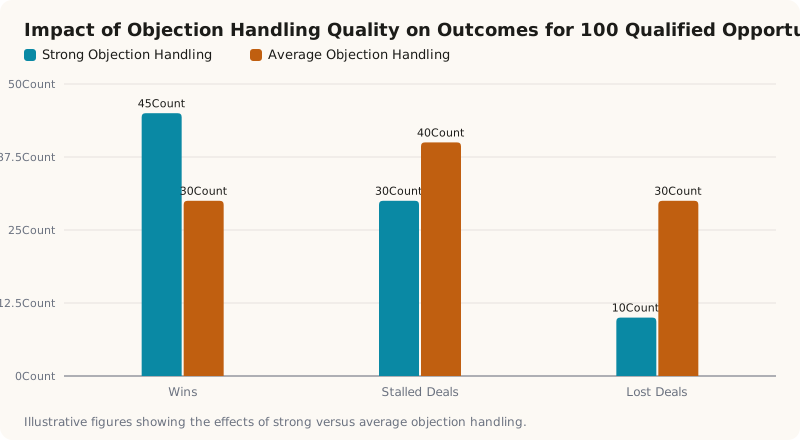 Illustrative figures showing the effects of strong versus average objection handling.
A lot of sales teams treat objections as a late-stage problem. In reality, objection handling is a measure of how well your team is selling from the first call onward.
If objections keep showing up around price, timing, or authority, that usually means one of three things:
- The rep did not uncover the buyer’s real priorities early.
- The rep did not build enough value before asking for the next step.
- The rep does not know how to separate a true objection from a polite stall.
Top-performing reps do not just react better. They create fewer unnecessary objections because they guide the conversation more clearly.
The business impact is measurable
Strong objection handling affects more than close rate. It improves:
- Conversion rate: more prospects move from discovery to proposal and from proposal to close.
- Deal quality: reps defend value better, so discounting drops.
- Sales cycle time: fewer circular conversations and fewer “follow up later” dead ends.
- Forecast accuracy: managers can tell which deals are truly at risk.
If your team closes 20% of qualified opportunities and improves objection handling enough to lift that to 25%, that is a 25% relative increase in wins without adding a single lead. That is not a minor improvement. That is revenue.
The four types of objections every rep must recognize
Objection Types and Best Response Approaches
| Objection Type | Example | Best Response Approach |
|---|---|---|
| Information | "Can you send me more details?" | Explain |
| Value | "I don't see the value in this solution." | Quantify |
| Risk | "What if this doesn't work for us?" | Reassure |
| Stall | "Let's discuss this next month." | Test |
Illustrative figures showing effective responses to different types of objections.
Not every objection means the same thing. If your team treats all objections as equal, they will respond with generic answers and lose credibility.
1. Information objections
These happen when the buyer genuinely lacks clarity.
Examples:
- “How does this integrate with our CRM?”
- “What does implementation look like?”
- “Who handles onboarding?”
These are usually the easiest to address because the buyer is asking for specifics, not hiding behind a wall.
2. Value objections
These are about whether the solution is worth the investment.
Examples:
- “I’m not sure this is worth the price.”
- “What makes this better than what we already have?”
- “Why should we change now?”
This is where many reps fail. They respond with features instead of business outcomes.
3. Risk objections
These come from fear of making the wrong decision.
Examples:
- “What if this doesn’t work for our team?”
- “We had a bad experience with another vendor.”
- “We can’t afford disruption.”
Risk objections require reassurance backed by proof: references, process, guarantees, pilot options, or clear implementation milestones.
4. Stall objections
These are the most common and often the most misleading.
Examples:
- “Send me something and I’ll review it.”
- “We’re too busy right now.”
- “Let’s circle back next quarter.”
Sometimes these are real. Often they are a polite way to avoid saying no. The rep’s job is to test whether there is a real issue underneath the delay.
A practical objection-handling framework: A.C.T.
Most salespeople talk too early. They hear an objection and immediately start pitching. That creates resistance.
Use a simple three-step framework instead: A.C.T.
A — Acknowledge
Start by showing you heard the concern.
Examples:
- “That makes sense.”
- “I understand why that would matter.”
- “Fair question.”
This is not agreement. It is emotional de-escalation.
C — Clarify
Ask a question that gets beneath the surface.
Examples:
- “When you say it’s expensive, are you comparing it to another vendor or to internal budget constraints?”
- “What would need to be true for this to be a priority this quarter?”
- “When you say send more information, what specific decision are you trying to make?”
Clarifying questions separate the real objection from the surface objection.
T — Test
Before you answer, test whether the concern is the real blocker.
Examples:
- “If we could solve that concern, would there be anything else standing in the way?”
- “Is that the main reason this has stalled?”
- “Would it make sense to explore the next step if we can address that?”
This prevents reps from over-answering the wrong issue.
Why A.C.T. works
It slows the conversation just enough to stop reactive selling. Instead of defending, the rep diagnoses. Instead of pitching, the rep leads.
A good rep is not the one with the fastest answer. It is the one with the clearest understanding of what is actually blocking the deal.
How to respond to the five most common objections
Every team hears variations of the same objections. The difference between average and strong teams is not exposure; it is preparation.
1. “It’s too expensive.”
Do not respond by discounting immediately. Price objections are often value objections in disguise.
Try this:
“Compared to what?”
Then follow with:
“If we compare it to the cost of the problem you’re trying to solve, what does that look like?”
Then quantify impact:
- Time lost per rep per week
- Revenue leakage from poor conversion
- Cost of delay over 90 days
- Manual work replaced by automation
Example:
If a sales team of 12 reps loses 3 hours a week to manual reporting, that is 36 hours weekly or roughly 144 hours a month. At even a modest loaded hourly cost, the “expensive” solution may be cheaper than the status quo.
2. “We’re already using a competitor.”
Do not attack the competitor. That makes you look insecure.
Instead say:
“That makes sense. What do you like most about what you have today?”
Then ask:
“What’s missing that you’d want solved better?”
This uncovers the gap. Buyers do not switch because they are curious. They switch because the current solution is no longer good enough.
3. “We don’t have budget.”
A budget objection can mean several things:
- The budget is truly unavailable.
- The buyer has not seen enough value.
- The deal is not important enough to reallocate money.
- The economic buyer is not involved.
Use a test question:
“If this were a priority, would budget be found?”
If the answer is no, you may have a timing problem. If the answer is yes, you have a value or sponsorship problem.
4. “Send me information.”
This is one of the most abused phrases in sales.
Instead of sending a generic brochure, respond with:
“Happy to. So I send the right material, what are you specifically trying to evaluate?”
If they still resist, ask:
“What would you need to see in that material to make it useful?”
If they cannot answer, they are likely stalling. That is your signal to propose a short next step rather than disappear into email follow-up.
5. “Now is not the right time.”
Timing objections must be tested, not accepted at face value.
Ask:
“What would make the timing better?”
Then:
“Is there a business event, budget cycle, or internal change driving that?”
Often, “not now” means the rep has not connected the solution to a compelling enough reason to move.
The difference between objection handling and argument
The worst mistake reps make is turning the conversation into a debate.
A buyer says, “This seems expensive.” The rep replies, “Actually, it’s very competitive.” The buyer pushes back. The rep counters again. The conversation becomes a contest, and the buyer usually wins by disengaging.
Replace defending with diagnosing
A strong rep never tries to win the objection in one sentence. They first find out:
- Is the concern real or a stall?
- Is the concern about value, risk, timing, or authority?
- Is the buyer the decision-maker or only an influencer?
- What outcome matters enough to justify change?
Use proof, not pressure
Good objection handling is supported by evidence:
- Case studies from similar customers
- Specific outcomes with percentages or time savings
- References from comparable industries
- Pilot programs with low-risk entry points
- Implementation timelines that reduce uncertainty
Pressure creates resistance. Proof creates confidence.
Practical tools and software that help teams improve objection handling
If you want objection handling to become a team skill rather than an individual talent, these tools help:
- Conversation intelligence / call recording — review real objections and coach specific replies. Examples: Gong, Chorus by ZoomInfo, Avoma.
- Sales enablement platforms — store objection libraries and talk tracks. Examples: Highspot, Seismic, Showpad.
- CRM systems — track where objections appear most often in the funnel. Examples: Salesforce, HubSpot, Pipedrive.
- Coaching scorecards — standardize how managers score objection handling. Examples: Google Sheets, Airtable, Notion templates.
- Role-play and training tools — support practice with real scenarios. Examples: Miro, Zoom, Microsoft Teams.
How managers can coach objection handling effectively
If your team is weak at objection handling, do not just tell them to “handle objections better.” That is not coaching. That is a wish.
Build an objection library
Collect the top 15 objections your team hears most often and document:
- The exact wording used by buyers
- The most likely meaning behind it
- The best clarifying question
- The best proof point or response
Review this in team meetings until responses become consistent.
Role-play the real objections
Do not role-play fake objections like “I need to think about it” with no context. Use actual deal scenarios.
For example:
- “The CFO wants ROI before we proceed.”
- “We’re comparing you to an incumbent vendor with a lower price.”
- “The champion likes us, but procurement is pushing back.”
Reps improve faster when practice mirrors reality.
Score the behavior, not just the outcome
In call reviews, score whether the rep:
- Acknowledged the objection
- Clarified the true issue
- Tested for the real blocker
- Responded with business relevance
- Advanced the conversation
If you only score closed-won or closed-lost, you miss the skill development opportunity.
Objection handling is really about trust
At its core, every objection is a trust test.
The buyer is asking:
- Do you understand my business?
- Are you listening, or just waiting to talk?
- Can you reduce my risk?
- Are you trying to help me make a good decision?
That is why scripted rebuttals alone do not work. A scripted rep sounds prepared, but not necessarily credible. A trained rep sounds calm, sharp, and useful.
The best sales teams know how to handle objections because they know how to think.
They do not panic at resistance. They do not oversell. They do not accept the first answer as the final answer.
They diagnose the concern, respond with relevance, and keep the deal moving.
Turn objection handling into a revenue advantage
If objections are slowing down your pipeline, reducing close rates, or forcing your team to discount too early, the issue is probably not just “better scripts.” It is a deeper skill gap in discovery, value communication, and deal control.
That is exactly where a structured training intervention pays off.
At Sales Bullseye, we look at objection handling as part of the full sales process, not as a standalone trick. We assess how your team uncovers needs, positions value, navigates risk, and moves buyers to the next step. Then we identify the exact gaps holding your team back.
If you want to find out whether your reps are losing deals because of poor objection handling, weak discovery, or inconsistent value messaging, book a Training Needs Assessment with Sales Bullseye. It is the fastest way to diagnose the real issue and build a practical plan to improve conversion.
Objection handling outcomes at a glance
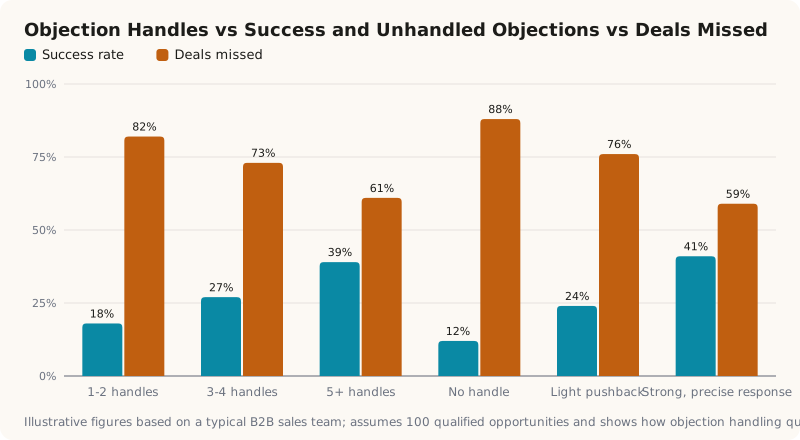 Illustrative figures based on a typical B2B sales team; assumes 100 qualified opportunities and shows how objection handling quality affects outcomes.
Ready to Audit Your Pipeline?
Get a high-level Training Needs Assessment for your sales organization.
About Nabeel Khalid
Nabeel is the founder of Sales Bullseye. He has trained hundreds of B2B sales professionals across Pakistan and the United States in the Bullseye Method — a high-integrity, methodology-led approach to complex deal closure built on retention, not one-off workshops.