Lead Qualification Frameworks That Save Time and Close More Deals

The Quick Take
Lead qualification is where revenue gets made or wasted. If your team qualifies too loosely, the pipeline fills with noise. If you qualify too aggressively, you throw away real opportunities. The goal is not to reject more leads — it is to
Lead qualification is where revenue gets made or wasted. If your team qualifies too loosely, the pipeline fills with noise. If you qualify too aggressively, you throw away real opportunities. The goal is not to reject more leads — it is to identify the right ones early enough to invest the right amount of time.
What Lead Qualification Actually Means
Lead qualification is the process of deciding whether a prospect is worth moving forward in the sales process. That sounds simple, but in practice it requires answering a few hard questions quickly:
- Does the prospect have a real business problem?
- Is the problem painful enough to drive action?
- Can they buy from us within a reasonable timeframe?
- Do we have a credible reason to believe we can help?
A lead is not qualified just because someone responded to outreach, booked a call, or downloaded a guide. Interest is not intent. Curiosity is not urgency. A qualified lead is one that matches your ideal customer profile, has a clear problem, and can realistically move toward a purchase.
Why qualification matters so much
Bad qualification creates three predictable problems:
- Salespeople spend time on deals that cannot close.
- Forecasts become unreliable because pipeline stages are inflated.
- Good opportunities get less attention because the team is busy with weak ones.
For most B2B teams, a small improvement in qualification has an outsized impact. If your team currently closes 15% of opportunities, and better qualification raises that to 20%, the improvement is not just 5 points. It is a major efficiency gain in meetings, proposals, and follow-up time.
The 5 Signals of a Qualified Lead
A useful qualification process should be simple enough for every rep to apply consistently. We recommend evaluating every lead against five signals:
1. Problem
There must be a real problem, not a vague interest. The best qualification starts with pain: missed revenue, high costs, low productivity, churn, compliance risk, or stalled growth.
A useful test is this: can the prospect describe the problem in their own words without you leading them?
Examples:
- “Our sales team is inconsistent across regions.”
- “We lose too many inbound leads before a rep responds.”
- “Our managers are coaching, but performance is still uneven.”
If the prospect cannot clearly articulate the issue, the urgency may be weak.
2. Impact
Not every problem is worth solving now. The issue must have enough business impact to justify action. Ask what happens if the problem stays unsolved for another quarter.
Strong impact statements sound like:
- “We are missing our quarterly target by 12%."
- “Our CAC has increased by 28% in six months.”
- “The team is spending 40% of time on unqualified leads.”
If the impact is minor, the buyer may like your solution but never prioritize it.
3. Authority
You do not need the final signer on every first call, but you do need access to decision-making influence. That may include the economic buyer, a champion, a manager, or an operations lead who can shape the purchase.
Ask:
- Who owns this problem?
- Who will evaluate options?
- Who signs off on the budget?
- Who else will need to be involved?
A deal without authority often becomes a long “send me the details” cycle that goes nowhere.
4. Timing
Timing is one of the most overlooked qualification signals. A lead may be a strong fit, but if the purchase is 9 to 12 months away, it should not consume the same attention as a deal closing this quarter.
Look for triggers:
- New funding
- Hiring sprees
- Leadership changes
- Low performance against target
- Tool consolidation or vendor replacement
- End-of-quarter or end-of-fiscal-year pressure
The best timing questions are direct:
- Why is this a priority now?
- What changed?
- What happens if you wait?
5. Fit
Fit is whether the lead matches your ideal customer profile and can actually benefit from your offer. A lead can have pain and urgency but still be a poor fit if your solution is built for a different market, size, or operating model.
Examples of fit criteria:
- Company size
- Industry
- Geographic region
- Sales team size
- Technology stack
- Complexity of buying process
Fit matters because it affects both win rate and implementation success. Selling to the wrong customer creates churn later, even if you close the deal.
Use a Qualification Framework, Not Gut Feel
Most sales teams claim they qualify leads. Many actually rely on intuition. The problem with gut feel is inconsistency: one rep moves every deal forward, another disqualifies too quickly, and managers cannot coach the process.
A framework creates shared language and repeatable decisions.
BANT is useful, but incomplete
BANT — Budget, Authority, Need, Timing — is one of the oldest qualification frameworks. It is still useful as a starting point, but it has limits.
The challenge is that BANT can become checkbox selling:
- “Do you have budget?”
- “Are you the decision-maker?”
- “Do you need this?”
- “When are you buying?”
Those questions often feel interrogative and can shut down discovery.
A better version of qualification adds business context:
- What problem are they trying to solve?
- What is the cost of doing nothing?
- What internal change or trigger created urgency?
- What does success look like in measurable terms?
A practical 6-question qualification model
Use these six questions during the first serious discovery call:
- What problem are you trying to solve?
- Why is this a priority now?
- What happens if you do nothing for 90 days?
- How are you measuring the cost of the current problem?
- Who else is involved in evaluating solutions?
- What criteria will matter most when choosing a vendor?
If the answers are vague, the lead is likely not qualified yet.
Score leads from 0 to 2 on each signal
For a simple internal scoring model, rate each of the five signals — problem, impact, authority, timing, and fit — from 0 to 2:
- 0 = weak or absent
- 1 = present but unclear
- 2 = strong and confirmed
Maximum score: 10
A practical threshold:
- 8–10: qualified, move forward
- 5–7: nurture or continue discovery
- 0–4: disqualify or recycle
This is not about forcing math into selling. It is about creating discipline. If a lead scores 3 on fit and 1 on timing, the rep should not behave as though it is a high-probability deal.
The Qualification Conversation: Questions That Reveal Reality
The best qualification happens through conversation, not scripts. Your goal is to uncover whether the problem is real and whether the deal can move.
Questions that surface urgency
Use these questions to separate interest from intent:
- What made you take this meeting now?
- What is not working with your current approach?
- What business result are you trying to improve?
- What is the cost of delaying a solution?
- Why is this worth addressing this quarter?
These questions help the buyer explain the business case in their own words.
Questions that expose decision dynamics
Many deals stall because the rep never learned how buying actually works inside the account.
Ask:
- How have similar purchases been made in the past?
- Who needs to be comfortable with the final decision?
- What concerns do you expect from finance, operations, or leadership?
- What would prevent this from moving forward?
This gives you a map of the buying process before it derails the deal.
Questions that qualify the opportunity size
You do not need a full ROI model on the first call, but you do need enough information to decide whether the opportunity is worth pursuing.
Ask:
- Roughly how many people or teams are affected?
- What is the volume of the problem each month or quarter?
- What is currently being spent to manage it?
- If we solved this, what would improvement be worth?
For example, if a company is losing 500 inbound leads per month because of slow response times, and each lead is worth even a modest amount, the business case becomes obvious. If a team is only losing 10 leads per quarter, the priority may be lower.
Qualification Mistakes That Quietly Kill Pipeline
Teams usually do not fail at qualification because they lack a framework. They fail because they apply the framework inconsistently.
Mistake 1: Confusing activity with qualification
A booked meeting is not a qualified opportunity. A demo is not a qualified opportunity. A proposal is not a qualified opportunity.
Qualification means the buyer has a real problem, real urgency, and a credible path to purchase. Without that, the deal is just moving through stages.
Mistake 2: Asking too many surface questions
Questions like “What keeps you busy?” or “Tell me about your company” do not qualify anything. They fill time but reveal little.
Better questions are specific and diagnostic:
- What is the cost of the current problem?
- What happens if this is not fixed?
- What are you using today, and what is not working?
Mistake 3: Qualifying on hope
Salespeople often stay attached to a deal because the contact is friendly or the account is strategically attractive. But if the buyer is not ready, those details do not matter.
Hope is not a sales strategy.
Mistake 4: Not disqualifying fast enough
Healthy pipelines depend on active disqualification. If a lead has no urgency, no fit, and no real next step, move it out of active sales.
This protects rep capacity. A team that disqualifies 20% to 30% of early-stage leads faster will usually spend more time on true opportunities and less time on dead ones.
Mistake 5: Letting managers tolerate weak qualification
If managers reward pipeline volume more than pipeline quality, reps will act accordingly. They will pad the forecast with weak deals and keep bad opportunities alive longer than they should.
Management discipline matters. If a deal has no confirmed pain, no compelling reason to act, and no next meeting, it should not sit in the forecast as if it is real.
Build a Qualification Process Your Team Will Actually Use
A qualification model only works if it fits the way your team sells.
Step 1: Define your ideal customer profile
Be specific. Not “mid-market companies” — define by revenue, team size, industry, and operational complexity. The more precise your ICP, the easier it is to qualify fit.
Step 2: Standardize your discovery questions
Every rep should know the core questions to ask in the first discovery call. Keep the list short enough to use, but deep enough to uncover business reality.
Step 3: Set clear exit criteria for stages
A lead should not move to the next stage until certain conditions are met. For example:
- Discovery complete only if pain, impact, and timing are confirmed
- Demo only if use case and stakeholders are identified
- Proposal only if evaluation criteria and next steps are agreed
Step 4: Review qualification quality in pipeline meetings
Do not just review stages and amounts. Review the quality of qualification:
- What problem did the buyer articulate?
- What triggered urgency?
- Who is involved?
- What is the timeline?
- What would cause the deal to stall?
This is how managers coach judgment, not just activity.
Step 5: Track conversion by source and rep
Look for patterns. Which lead sources produce the highest qualification rate? Which reps overstate opportunity quality? Which channels generate lots of meetings but low close rates?
Data will show whether your qualification process is actually working.
Practical tools and software that help qualification teams
If you want qualification to become a repeatable team discipline, these tools can help:
- CRM systems — track lead stages, source, and conversion. Examples: Salesforce, HubSpot, Pipedrive.
- Conversation intelligence / call recording — review discovery calls and qualification moments. Examples: Gong, Chorus by ZoomInfo, Avoma.
- Sales engagement platforms — manage outreach and follow-up sequences. Examples: Outreach, Salesloft, Apollo.
- Scorecard and note tools — standardize qualification notes and decision criteria. Examples: Notion, Airtable, Google Sheets.
- Forms and surveys — capture lead intake and qualification data cleanly. Examples: Typeform, Google Forms, Microsoft Forms.
Turn Qualification Into a Competitive Advantage
Good qualification is not about being selective for the sake of it. It is about focusing your team on the opportunities that deserve time, attention, and forecast confidence.
When qualification is strong, everything improves:
- Sales conversations become sharper
- Forecasts become more reliable
- Reps spend less time chasing noise
- Managers coach more effectively
- Close rates improve because the pipeline is cleaner
The biggest mistake is treating qualification as a one-time step at the start of the funnel. Real qualification is continuous. A lead that looked strong in week one may weaken by week three. A slow-moving deal may become urgent after a trigger event. The best teams keep qualifying all the way through the cycle.
If your team is generating activity but struggling with low-quality pipeline, inconsistent discovery, or forecast misses, the issue is often not effort — it is qualification discipline. Sales Bullseye helps teams build practical sales systems that improve pipeline quality, conversation quality, and coaching quality.
If you want to know whether your team is asking the right questions, qualifying the right opportunities, and managing the funnel with discipline, book a Training Needs Assessment with Sales Bullseye. We will identify the gaps in your current process and map the training that will improve conversion where it matters most.
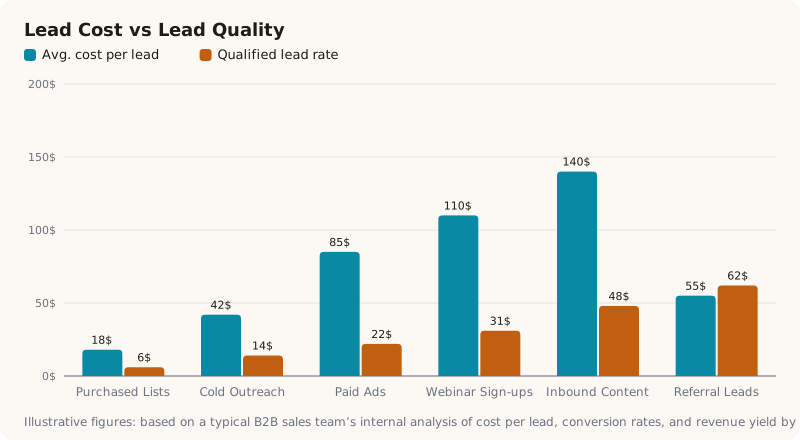 Illustrative figures: based on a typical B2B sales team’s internal analysis of cost per lead, conversion rates, and revenue yield by lead source.
Ready to Audit Your Pipeline?
Get a high-level Training Needs Assessment for your sales organization.
About Nabeel Khalid
Nabeel is the founder of Sales Bullseye. He has trained hundreds of B2B sales professionals across Pakistan and the United States in the Bullseye Method — a high-integrity, methodology-led approach to complex deal closure built on retention, not one-off workshops.