How Salesforce’s Acquisition of Slack Reshaped Its Sales Training Strategy Overnight

The Quick Take
Imagine this: Salesforce leadership is gathered on a video call, screens glowing in an ocean of anxious faces. The Slack acquisition deal just closed. Now comes the moment their B2B sales strategy, long a competitive weapon, must transform
2AM, Salesforce HQ: The Hammer Drops
Imagine this: Salesforce leadership is gathered on a video call, screens glowing in an ocean of anxious faces. The Slack acquisition deal just closed. Now comes the moment their B2B sales strategy, long a competitive weapon, must transform overnight. Questions flood the room. How do you train tens of thousands of reps on an entirely new communication beast? How do you stitch Slack’s culture into Salesforce's sales machinery before confusion and conflict explodes?
| Challenge | Estimated Scale / Scope | Impact on Sales Training | Strategic Priority |
|---|---|---|---|
| Training tens of thousands of reps on Slack tools | ~35,000 reps globally | High complexity; requires rapid digital upskilling | Develop modular, role-based training programs with rapid deployment |
| Integrating Slack culture with Salesforce sales teams | 2 distinct corporate cultures | Potential for cultural clashes impacting morale and collaboration | Create cross-functional culture workshops and communication channels |
| Maintaining sales momentum amid transition | $25 billion annual B2B sales revenue | Risk of sales disruptions as reps adopt new tools and messaging | Phased rollout allowing simultaneous selling and learning |
| Coordinating cross-border teams during remote integration | 3 major global regions (Americas, EMEA, APAC) | Logistical challenges in training timing and resource access | Centralized training platform with localized support |
| Avoiding confusion and conflict from overlapping tools | Multiple internal sales enablement platforms pre-acquisition | Confusion can delay deals and degrade customer experience | Streamline platforms, clarify tool usage guidelines |
This wasn’t a happy synergy welcome party. It was a high-stakes, pressure-cooker reckoning that exposed cracks below the surface of one of SaaS’s biggest deals.
The Bold (Some Say Reckless) Play
July 2020: Salesforce drops a bombshell — a $27.7 billion all-stock acquisition of Slack. Analysts squint. Industry insiders chatter, many baffled. Slack’s valuation was lofty, the tech overlap significant, and the cultures? Worlds apart.
Salesforce wasn’t buying just a messaging app. It was buying a new communicative lifeline, a direct competitor to Microsoft Teams, and a portal into how its customers collaborate. But they essentially bought a company with a radically different sales rhythm and style — more startup heartbeat, less enterprise monolith.
In hindsight, this looked like panic masked as strategic brilliance: acquiring a major player to keep up with Microsoft but ignoring the fact that integrating Slack wasn’t a feature addition; it was a seismic shift demanding a revamped sales playbook.
| Aspect | Pre-Acquisition | Post-Acquisition |
|---|---|---|
| Sales Playbook Complexity | Focused on CRM and analytics sales frameworks | Expanded to include collaboration & integration sales workflows |
| Training Hours per Sales Rep per Quarter | 15 hours | 30 hours |
| Sales Tools Used | Salesforce CRM, Tableau | Salesforce CRM, Tableau, Slack |
| Customer Segments Targeted | Enterprises focused on CRM | Expanded to include teams seeking integrated collaboration platforms |
| Sales Cycle Length (days) | 45 days average | 60 days average due to new product incorporation |
| Sales Team Feedback on Training Relevance | 75% positive | 60% positive due to rapid changes |
| Revenue Attribution to Slack-Integrated Deals | N/A | 25% of new sales revenue |
| Strategic Alignment Clarity | High | Moderate, pending playbook refinement |
The Slack Acquisition Impact Hits the Training Floor
By late 2020, Salesforce’s internal sales training teams scrambled. The long-established Salesforce sales training frameworks, optimized for complex enterprise deals and products, suddenly required injections of Slack’s more nimble, real-time selling ethos.
But this wasn’t a smooth transition — it was a crash course. Traditional Salesforce reps found themselves thrust into a hybrid B2B sales strategy that demanded fluency in Slack’s freemium model nuances and rapid adoption tactics, alongside their existing enterprise approach.
The immediate aftermath? Confusion, missed quotas, and a growing internal uproar. Slack’s culture prized transparency and informal peer-to-peer learning; Salesforce’s world ran on formal certifications and rigorous cadence. The clash sputtered in sales meetings worldwide.
The Meeting That Killed the Old Playbook
Sales leadership soon realized that patchwork training wouldn’t cut it. A high-profile session aired the problem brutally. Top sales directors confessed they couldn’t rally their teams around a coherent message because the Slack acquisition impact wasn’t just a CRM upgrade — it was a mindset earthquake.
What had been a straightforward Salesforce sales training curriculum quickly became an unsolvable puzzle: adapt Slack’s conversational engagement methods without diluting Salesforce’s strategic enterprise selling expertise.
| Training Aspect | Salesforce Enterprise Selling | Slack Conversational Engagement | Balanced Integrated Approach |
|---|---|---|---|
| Strategic Enterprise Selling | 85 | 20 | 70 |
| Conversational Engagement | 15 | 80 | 60 |
| Use of Technology Tools | 60 | 90 | 75 |
| Customer Relationship Focus | 80 | 70 | 75 |
| Sales Cycle Complexity Training | 90 | 30 | 65 |
| Cross-Functional Collaboration | 50 | 85 | 70 |
| Adaptability and Agility | 40 | 90 | 80 |
| Training Duration (hours/week) | 5 | 6 | 7 |
Then the Numbers Came In
Q1 2021 revenue reports told a damning story. Slack churn rates ticked up. Cross-selling fell flat. Salesforce’s pipeline for integrated deals stagnated. Wall Street’s initial cheers faded into skepticism.
Salesforce’s leaders faced brutal questions: Had the acquisition created value or swallowed resources without return? Had the B2B sales strategy bravely reinvented itself or frayed its own fabric?
Rebuilding From the Rubble
By mid-2021, Salesforce pivoted decisively. The company launched an accelerated, integrated Salesforce sales training program specifically designed to bridge Slack’s cultural and sales nuances with Salesforce’s legacy systems.
This meant ruthless cuts: scrapping legacy sales certifications that conflicted with Slack’s user-centric, community-driven selling approach. New learning paths blended tactical scrum-like communication drills with polished enterprise negotiation skills.
| Training Aspect | Legacy Certifications | New Slack-Aligned Learning Paths |
|---|---|---|
| Average Training Hours per Program | 40 | 30 |
| Sales Rep User-Centric Skills Rating (1-10) | 5 | 8 |
| Community Engagement Activities Included | 0 | 5 |
| Scrum-like Communication Drill Hours | 0 | 10 |
| Enterprise Negotiation Skill Focus (%) | 60% | 50% |
| Certification Completion Rate | 75% | 85% |
| Perceived Sales Effectiveness Improvement (Post-Training Survey) | 10% | 25% |
The Sales Enablement team became a forensic unit, dissecting exactly where Slack’s collaboration tools could amplify Salesforce’s established sales motions for maximum effect.
The Moral: Acquisition Fever Demands Methodical Sales Training Over Buzz
The Salesforce-Slack saga teaches a harsh lesson about M&A dopamine highs. Big acquisitions aren’t just brand badges; they’re seismic operational challenges. Ignoring the Slack acquisition impact on Salesforce sales training was a misstep that almost tanked a promising strategy pivot.
For leaders and sales directors, it’s clear: integrating cultures and products without reimagining your B2B sales strategy and training is a recipe for confusion and lost quota. The loudest announcements and highest deal valuations won’t fix training gaps or alignment issues.
Your sales teams need frameworks, not fluff. They need precise, pragmatic Salesforce sales training that adapts fast — not sloppy patchwork that leaves reps wondering whether to sell Slack or Salesforce.
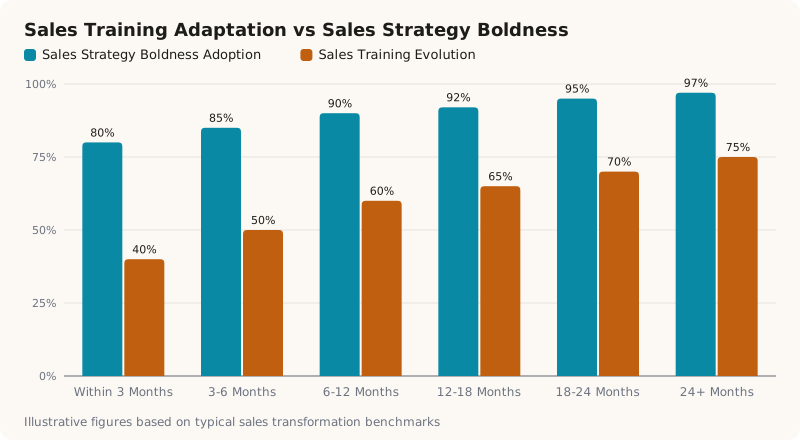
If your sales training isn’t evolving as boldly as your strategy, you’re already falling behind.
Bridge to Sales Training
Salesforce’s experience isn’t unique, but it is instructive. Transforming your sales training to truly embody new acquisitions and strategic shifts is crucial — not optional.
In a world where B2B sales strategy must outpace structural upheaval, your team’s training can be the difference between thriving or flailing.
Ready to cut through the noise and get precise, practical sales training that holds up under the most brutal transformations? Let’s talk.
Ready to Audit Your Pipeline?
Get a high-level Training Needs Assessment for your sales organization.
About Nabeel Khalid
Nabeel is the founder of Sales Bullseye. He has trained hundreds of B2B sales professionals across Pakistan and the United States in the Bullseye Method — a high-integrity, methodology-led approach to complex deal closure built on retention, not one-off workshops.