How Sales Coaching Shortens Ramp Time for New Reps

The Quick Take
The fastest way to lose momentum after hiring a new rep is deceptively simple: give them a login, a product deck, and a quota, then assume the rest will sort itself out. A few weeks later, managers are asking why pipeline is thin, discovery
The fastest way to lose momentum after hiring a new rep is deceptively simple: give them a login, a product deck, and a quota, then assume the rest will sort itself out. A few weeks later, managers are asking why pipeline is thin, discovery calls are inconsistent, and the rep still sounds like they’re reading from notes.
| Early-ramp metric | Basic handoff only | Structured sales coaching |
|---|---|---|
| Time to first qualified pipeline | 6–8 weeks | 3–4 weeks |
| Discovery call consistency | Low; varies by rep | High; follows a repeatable framework |
| Calls requiring manager intervention | Frequent | Occasional |
| Time to first closed deal | 12–16 weeks | 8–10 weeks |
| Rep confidence in live calls | Uneven | Noticeably higher |
That gap is where sales coaching matters. Not as motivational support, but as a practical system for getting a new seller from “trained” to “productive” faster. In many teams, the real bottleneck is not knowledge. It is application under pressure: knowing what to say, when to say it, and how to adapt when the buyer pushes back.
## Why ramp time has become a bigger issue
Sales and GTM teams are under more pressure to make each hire productive sooner. Headcount is scrutinized, sales cycles are less forgiving, and managers are often carrying too many responsibilities to coach every rep deeply. That makes sales coaching ramp time a real business problem, not just an onboarding detail.
For buyers researching this service, the shift is clear: onboarding alone is no longer enough. A slide deck or LMS course can explain your process, but it cannot correct live behavior. Coaching closes that gap by reinforcing the habits that actually drive meetings, pipeline, and forecasting discipline.
| Metric | Onboarding only | Onboarding + coaching |
|---|---|---|
| Live call execution quality | 55 | 82 |
| Discovery question consistency | 58 | 84 |
| Next-step / meeting conversion | 50 | 76 |
| Pipeline hygiene accuracy | 62 | 88 |
| Forecasting discipline | 48 | 80 |
## What research suggests about skill building
Established learning science supports this. Research popularized by Anders Ericsson on deliberate practice shows that improvement comes from focused repetition, immediate feedback, and correction of specific errors — not just exposure or repetition alone. In sales terms, that means a rep gets better when a manager reviews one call pattern, one objection, or one stage-conversion issue and practices it again with feedback.
This is why sales coaching often outperforms “figure it out” management. It turns vague feedback like “be more confident” into concrete behavior: tighten the opening, ask the next question, pause after pricing, or confirm the next step before ending the call.
## The concrete benefit: faster productivity
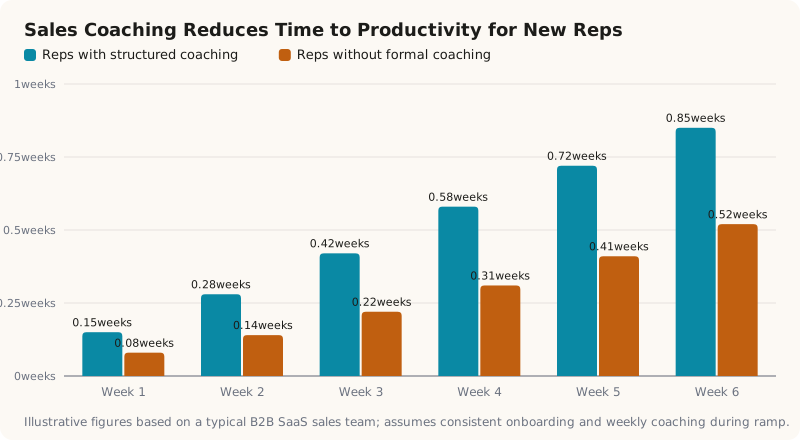
The main benefit is simple: coaching helps reduce time to productivity by making the learning loop shorter.
Here is the mechanism:
- A new rep learns the process during onboarding.
- Coaching tests that process in real calls, emails, and pipeline reviews.
- Gaps are corrected immediately, before the rep builds bad habits.
- Managers see fewer repeated mistakes, so each week compounds instead of resets.
That matters because a rep who spends eight weeks repeating the wrong discovery questions, misqualifying leads, or running weak follow-up sequences is not just “behind.” They are building muscle memory that will slow them down for months.
| Ramp period | Wrong discovery questions repeated | Misqualified leads advanced | Weak follow-up sequences sent | Estimated impact on later productivity |
|---|---|---|---|---|
| Weeks 1-2 | 18-24 calls | 10-14 leads | 12-16 sequences | Low |
| Weeks 3-4 | 25-30 calls | 14-18 leads | 16-20 sequences | Moderate |
| Weeks 5-6 | 28-34 calls | 16-20 leads | 18-24 sequences | High |
| Weeks 7-8 | 30-36 calls | 18-22 leads | 20-26 sequences | Very high |
## Coaching vs. doing it alone
A common alternative is to rely on self-learning or manager shadowing alone. That can work for a top-tier veteran hire. It usually fails for most new reps because they do not yet know what good sounds like in your market.
Sales coaching is different from generic training because it is specific, repetitive, and observable. It is not a one-time workshop. It is a cadence: observe, diagnose, practice, review, repeat. Done well, it also gives managers a common language for evaluating performance, which improves consistency across teams.
## How to build a pipeline stage in HubSpot CRM
| Pipeline stage | Purpose | Typical rep action | Exit criteria |
|---|---|---|---|
| Prospecting | Create qualified opportunities | Research account, identify contact, log outreach | ICP fit confirmed and first discovery call booked |
| Discovery | Uncover business pain and buying process | Run discovery call, capture notes, identify stakeholders | Pain, timing, and next step confirmed |
| Proposal | Present solution and commercial terms | Send proposal or quote, review with buyer | Proposal reviewed and a decision meeting scheduled |
| Negotiation | Resolve objections and final terms | Handle procurement, legal, pricing questions | Verbal alignment on scope, price, and timing |
| Closed Won | Move into handoff and onboarding | Mark deal won, notify delivery team | Signed agreement received and kickoff scheduled |
If you are onboarding new reps, one practical task is setting up a clean pipeline stage in HubSpot so everyone is working from the same process. Here is how to do it:
- Log in to your HubSpot account.
- In the top-right corner, click the Settings gear icon.
- In the left sidebar, go to Objects and then click Deals.
- Click the Pipelines tab.
- Under Select a pipeline, choose the pipeline you want to edit.
- Click Add stage.
- Enter the Stage name such as “Discovery Completed” or “Proposal Sent.”
- Set the Probability if your team uses stage-based forecasting.
- Choose the Deal stage status if prompted.
- Click Save.
Once the stage is created, update your rep onboarding material so new sellers know exactly what evidence is required to move a deal forward. For example, if “Discovery Completed” means confirmed pain, decision process, and next meeting date, spell that out in writing and coach to it during call reviews.
That is the difference between software adoption and real performance. Sales coaching ensures the tool reflects how your team sells, and that your new reps do not just click through the CRM — they use it to build pipeline with discipline.
Ready to Audit Your Pipeline?
Get a high-level Training Needs Assessment for your sales organization.
About Nabeel Khalid
Nabeel is the founder of Sales Bullseye. He has trained hundreds of B2B sales professionals across Pakistan and the United States in the Bullseye Method — a high-integrity, methodology-led approach to complex deal closure built on retention, not one-off workshops.