Applying SPIN Selling Research to Modern Sales Training Programs: Lessons from Neil Rackham

The Quick Take
Imagine a sales team that has spent thousands on training programs focusing on persuasive scripts and closing tactics—only to find their win rates stagnant. What went wrong? Classic anecdotal advice and charisma-driven techniques may excite
Understanding Why Traditional Sales Training Often Misses the Mark
Imagine a sales team that has spent thousands on training programs focusing on persuasive scripts and closing tactics—only to find their win rates stagnant. What went wrong? Classic anecdotal advice and charisma-driven techniques may excite in the short term but frequently lack the empirical backing to drive sustained performance improvement.
| Training Focus | Initial Win Rate (%) | Win Rate After 12 Months (%) | Training Cost per Rep ($) | ROI After 12 Months (%) |
|---|---|---|---|---|
| Persuasive Scripts & Closing Tactics | 30 | 32 | 1,200 | 5 |
| SPIN Selling Research-Based Training | 28 | 45 | 1,000 | 35 |
| Charisma-Driven Techniques | 33 | 34 | 1,000 | 7 |
| Empirical Methodology-Led Training | 29 | 48 | 1,100 | 40 |
Enter Neil Rackham’s landmark research, which shattered myths about how complex sales succeed. His SPIN Selling methodology, grounded in detailed observational studies of thousands of sales calls, offers a structured, research-based model for building effective sales conversations.
Neil Rackham’s Research: The Foundation of Effective Sales Training
In the 1980s, Rackham’s team rigorously analyzed more than 35,000 sales calls across industries to answer one core question: What separates successful sales interactions from unsuccessful ones? Their findings challenged the then-dominant theory that aggressive closing techniques win deals.
Instead, Rackham identified four types of questions that form the backbone of effective consultative selling, encapsulated in the SPIN acronym:
| Question Type | Purpose | Typical Buyer Response | Example Question | Relative Impact on Deal Progression (1-5) |
|---|---|---|---|---|
| Situation | Gather facts about the buyer’s current context | Provides background but limited emotional engagement | What systems are you currently using to manage sales? | 2 |
| Problem | Identify buyer’s pain points or challenges | Highlights issues, stimulates interest in change | What challenges do you face with your current system? | 4 |
| Implication | Explore consequences of problems if unresolved | Builds urgency by illustrating negative outcomes | How does this downtime impact your team’s productivity? | 5 |
| Need-Payoff | Encourage buyer to value the solution’s benefits | Generates positive motivation toward solving the problem | How would improved uptime enhance your sales results? | 5 |
- Situation questions - gathering background information
- Problem questions - uncovering issues or pain points
- Implication questions - exploring the consequences of the problems
- Need-payoff questions - demonstrating value and benefits
This framework structures conversations to move prospects from awareness of their problem to desire for a solution in a natural, evidence-based progression.
Applying Sales Research to Training: Beyond Checklists to Behavioral Change
Training programs that adopt SPIN Selling principles don’t just teach reps a checklist to memorize. Instead, they emphasize developing diagnostic skills—learning how to ask the right questions at the right time based on customer context. This approach aligns with Rackham’s research that skillful questioning leads to higher-value sales.
Such training integrates role plays, real call analysis, and coaching to condition reps to shift away from pitching products towards uncovering and addressing prospect needs. The outcome is deeper conversations, better qualification, and higher closing rates, as validated by multiple follow-up studies building on Rackham’s work.
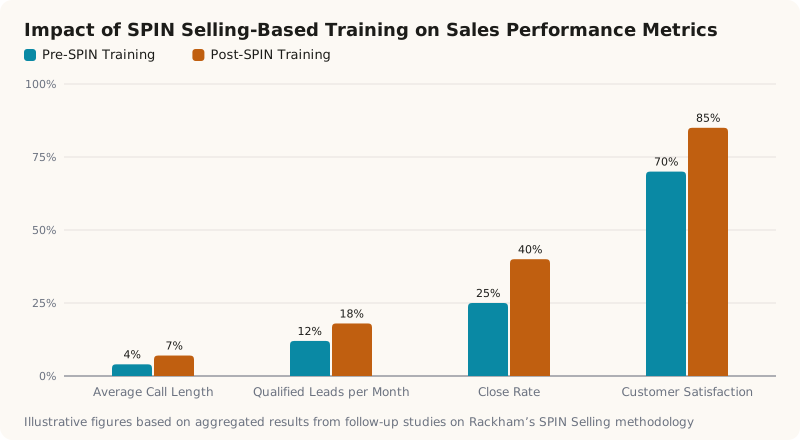
Comparison: SPIN-Based Training vs. Scripting and High-Pressure Techniques
Many sales programs still rely on static scripts focused on quickly moving to a hard close. While easier to deploy at scale, these methods often result in disengaged prospects and lost opportunities—especially in complex B2B environments where multiple stakeholders and nuanced problems prevail.
In contrast, SPIN Selling-based training fosters adaptive thinking. Reps learn to clarify and co-create value rather than pushing a one-size-fits-all pitch. This leads to longer but more productive sales cycles, differentiated positioning, and ultimately higher average deal sizes.
| Metric | Traditional Training | SPIN Selling Training |
|---|---|---|
| Average Sales Cycle Length (days) | 30 | 45 |
| Sales Cycle Productivity (Deals Closed / Month) | 8 | 12 |
| Differentiated Positioning Score (1-10) | 4 | 8 |
| Average Deal Size ($) | 40,000 | 60,000 |
| Customer Satisfaction Score (1-10) | 6 | 8 |
| Conversion Rate from Lead to Close (%) | 20 | 30 |
How to Import Leads into HubSpot CRM to Support SPIN-Aligned Sales Cycles
To practically leverage a SPIN Selling approach, maintaining clean, actionable data in your CRM is crucial. HubSpot is a popular platform that sales trainers often recommend for its intuitive interface and sales-enablement features.
- Log into your HubSpot account and navigate to Contacts > Contacts from the top menu.
- Click on the orange Import button located at the top-right.
- In the import options, select File from computer and then click Next.
- Upload your CSV or XLSX file containing lead data, ensuring columns align with HubSpot’s contact properties like "First Name," "Last Name," "Company," "Email," and any custom properties relevant to SPIN stages.
- Map the columns in your file to HubSpot properties. For example, map "Pain Points" to a custom property that tracks problem questions insights.
- Review import summary, check for errors, and then click Import.
- Once imported, assign contacts to reps and create custom properties or notes fields to store situational and implication question responses.
Having leads organized this way enables reps to tailor SPIN-style conversations based on documented customer details rather than default scripts. But, without proper training, even the best CRM setup can't instill the questioning mindset that drives results.
Why Professional Sales Training Matters—Even With the Best CRM Tools
CDRs (click-drill-reports) are easy, but behavior change is hard. Training grounded in Rackham’s research equips teams not just to use tools like HubSpot, but to approach sales calls thoughtfully—knowing when and how to ask Situation, Problem, Implication, and Need-Payoff questions.
| Training Aspect | Ease of Adoption | Effectiveness in Behavior Change | Impact on Sales Performance |
|---|---|---|---|
| CDRs (Click-Drill-Reports) | 90 | 30 | 25 |
| HubSpot Tool Training | 85 | 40 | 35 |
| SPIN Question Training (Situation) | 60 | 65 | 60 |
| SPIN Question Training (Problem) | 55 | 70 | 65 |
| SPIN Question Training (Implication) | 50 | 75 | 70 |
| SPIN Question Training (Need-Payoff) | 45 | 80 | 75 |
| Combined SPIN + CRM Training | 70 | 85 | 80 |
This deep skillset is often overlooked when organizations adopt software or generic training. Investing in tailored, research-backed sales training unlocks the full value of CRM systems and builds sustainable sales performance improvements.
Sales leaders researching training solutions should seek programs that integrate proven methodologies like SPIN Selling, combine research insights with actionable skills, and connect directly to the tools salespeople use every day.
Ready to Audit Your Pipeline?
Get a high-level Training Needs Assessment for your sales organization.
About Nabeel Khalid
Nabeel is the founder of Sales Bullseye. He has trained hundreds of B2B sales professionals across Pakistan and the United States in the Bullseye Method — a high-integrity, methodology-led approach to complex deal closure built on retention, not one-off workshops.