Amazon's Layoffs: What This Means for E-Commerce SEO Optimization

The Quick Take
Amazon, the company that turned “more” into a business model, has spent the last few years doing something that would make old-school operators spit out their coffee: trimming tens of thousands of jobs across multiple rounds. The biggest he
The giant blinked. Then it cut deep.
Amazon, the company that turned “more” into a business model, has spent the last few years doing something that would make old-school operators spit out their coffee: trimming tens of thousands of jobs across multiple rounds. The biggest headline-grabber came in 2023, when Amazon announced plans to eliminate 18,000 roles, then followed with more reductions later that year and into 2024 as part of a broader cost reset. This was not a tiny correction. This was a giant admitting that scale alone does not excuse sloppiness.
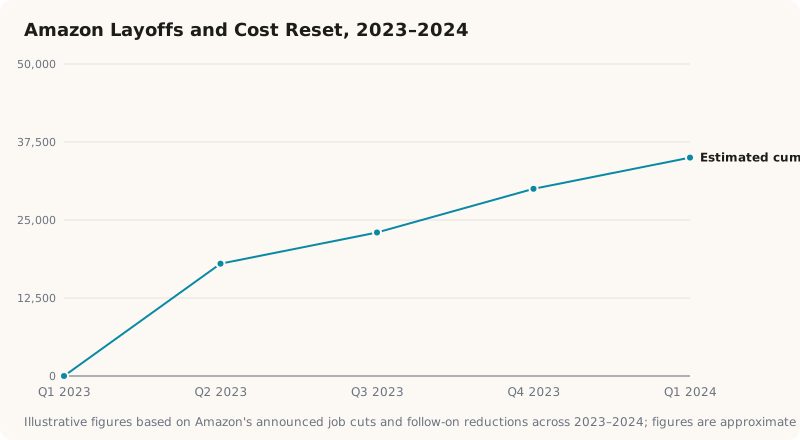
And yes, the market noticed. When a company built on relentless expansion starts laying off people in waves, the signal is louder than the press release. It says the era of “growth at any cost” is over. Or at least it should be.
The meeting that killed the fantasy
Let’s strip away the drama and look at the business logic. Amazon was not suddenly “broken.” That would be lazy commentary. What happened was more interesting, and more common: the company had overbuilt in some areas, hired into uncertainty, and then hit a wall where revenue growth, margin pressure, and macro conditions stopped flattering the org chart.
After the pandemic surge, e-commerce normalized. Not collapsed. Normalized. That’s the word executives hate because it removes the excuse. Consumers kept buying online, but not at the same absurd clip. Costs rose. Logistics got messy. Investors got bored with grand promises and started asking for discipline. That’s when the scythe comes out.
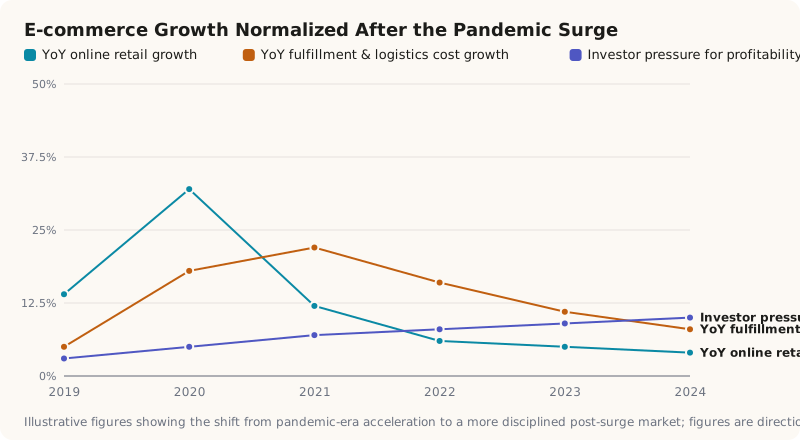
Amazon’s layoffs were not just about headcount. They were about prioritization. Somewhere in the machine, somebody realized that too many teams were probably chasing too many experiments, too many dashboards, too many “strategic initiatives” that sounded smarter than they were. Classic corporate vanity project behavior. The kind that burns money while pretending to be innovation.
What everyone is missing while staring at the job cuts
The loudest mistake people make is treating Amazon layoffs as a pure tech headline. They are not. They are a search-demand headline, a retail headline, and a merchandising headline.
Why? Because when a company like Amazon tightens the screws, the pressure moves downstream. Sellers get more competitive. Inventory gets more expensive to carry. Ad auctions get uglier. And in e-commerce, visibility is oxygen. If your product pages are sloppy, your category architecture is bloated, and your content is built like a brochure from 2016, you will feel it fast.
This is where e-commerce SEO gets interesting. Not the fluffy version people sell at conferences. The real version: technical crawlability, category page structure, internal linking, query intent matching, conversion-ready copy, and ruthless SEO optimization of product detail pages. Because when the market gets harder, nobody forgives weak discoverability.
| SEO lever | Primary role | Typical impact on organic traffic | Typical impact on conversion rate |
|---|---|---|---|
| Technical crawlability | Makes pages discoverable and indexable | 18% | 4% |
| Category page structure | Improves topical relevance and ranking breadth | 17% | 6% |
| Internal linking | Distributes authority and helps users navigate | 14% | 3% |
| Query intent matching | Aligns pages with search intent | 16% | 8% |
| Conversion-ready copy | Improves persuasion and on-page clarity | 8% | 12% |
| Product detail page optimization | Increases rankings and product-page conversion | 27% | 15% |
Amazon’s own marketplace dominance also throws a spotlight on a brutal truth: many brands have confused traffic with strategy. They rely too heavily on paid channels, then act surprised when CPCs rise and margins get squeezed. That is not a marketing plan. That is a dependency. And dependencies become liabilities the moment the platform changes the rules.
The smarter reading of Amazon’s layoffs is not “AI replaced everyone” or “remote work failed” or whatever simplistic narrative is trending this week. It’s that operational bloat is easy to hide during boom times, and impossible to ignore when the growth curve bends. The companies that survive the next cycle will not be the loudest. They’ll be the cleanest.
The takeaway: what sales and business teams should actually do
1. Stop mistaking motion for progress. If your team is busy but your funnel is flat, you do not have momentum. You have theater.
| Activity area | Before | After | Interpretation |
|---|---|---|---|
| Sales outreach volume | 12,400 touches/month | 18,900 touches/month | Busy work increased |
| Website traffic | 48,000 visits/month | 62,000 visits/month | Top-of-funnel activity rose |
| Lead-to-opportunity conversion | 3.8% | 3.7% | No meaningful improvement |
| Qualified pipeline created | $1.42M/month | $1.45M/month | Funnel output stayed flat |
| Closed-won revenue | $410K/month | $405K/month | Results did not move |
2. Treat discoverability like a revenue function. In e-commerce, e-commerce SEO is not a side quest. It is how buyers find you when paid media gets expensive and brand demand softens.
3. Build for margin, not vanity. A channel that drives traffic but destroys profitability is not “growth.” It is expensive self-deception.
4. Audit the weakest links before the market does. Product content, site structure, search intent, sales follow-up, and conversion paths all matter. Miss one, and the whole machine leaks.
From layoffs to leverage
Amazon’s layoffs are a reminder that scale does not protect you from bad discipline. It just lets you hide it longer. The same rule applies to sales teams and e-commerce operators: if your search visibility, messaging, and funnel mechanics are weak, growth will eventually expose the rot.
| Metric | Weak discipline | Disciplined execution | What it means |
|---|---|---|---|
| Organic search visibility (page-1 rankings share) | 18% | 42% | More qualified traffic lands on the site |
| Product page conversion rate | 1.6% | 3.4% | Messaging and offer clarity convert more visitors |
| Cart abandonment rate | 78% | 62% | Cleaner checkout reduces leakage |
| Email/SMS recovery rate on abandoned carts | 6% | 14% | Stronger follow-up recaptures demand |
| Revenue growth at same traffic level | 4% | 19% | Operational discipline lifts output without more spend |
That’s why Seo consulting matters here. Not as a buzzword. As a repair job. If your brand needs sharper SEO optimization, cleaner category strategy, and a search plan that actually supports revenue, that’s where the conversation should start.
Need a blunt review of where your e-commerce SEO is leaking revenue? Let’s talk.
Ready to Audit Your Pipeline?
Get a high-level Training Needs Assessment for your sales organization.
About Nabeel Khalid
Nabeel is the founder of Sales Bullseye. He has trained hundreds of B2B sales professionals across Pakistan and the United States in the Bullseye Method — a high-integrity, methodology-led approach to complex deal closure built on retention, not one-off workshops.