9 Critical Mistakes Companies Make When Measuring Sales Training ROI

The Quick Take
Imagine this: you’ve just wrapped a sizeable sales training initiative with your frontline team. You spent weeks on content, sessions, and role-playing exercises—yet, when reviewing performance a quarter later, your sales numbers show littl
Introduction: When Sales Training Dollars Don’t Tell the Full Story
Imagine this: you’ve just wrapped a sizeable sales training initiative with your frontline team. You spent weeks on content, sessions, and role-playing exercises—yet, when reviewing performance a quarter later, your sales numbers show little improvement. How do you explain this disconnect to your CEO or board?
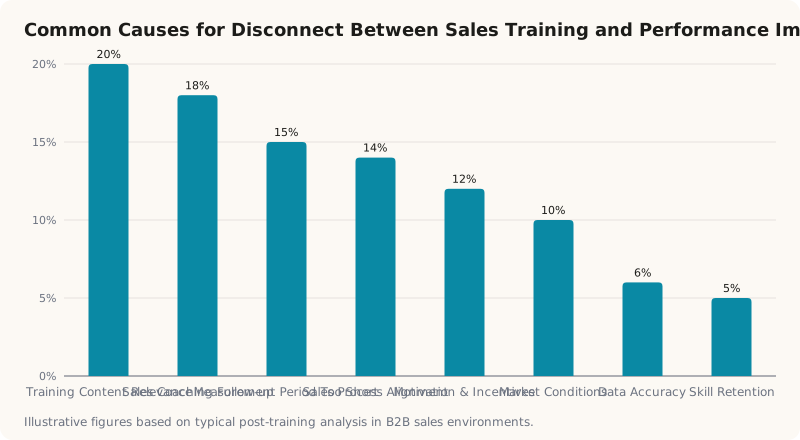
This scenario is all too common. Companies invest heavily in sales training yet stumble when measuring sales training ROI. The mistakes behind these flawed measurements often stem from misunderstanding what to measure, how to measure it, and when. Let’s explore nine critical mistakes organizations make — and what to do instead.
1. Focusing Only on Short-Term Metrics
Many firms evaluate sales training by immediate metrics like post-training test scores or initial deal closures. However, Kirkpatrick’s Four Levels of Training Evaluation highlight that reaction and learning are just the first steps. Behavior change and business results come later and require ongoing tracking. Failing to account for this timeline leads to premature conclusions about ROI.
2. Ignoring Qualitative Feedback from the Field
Metrics like deal size or win rate tell part of the story, but frontline sales managers’ observations provide contextual insight into whether reps actually apply new skills on calls or negotiate differently. Overlooking qualitative input reduces understanding of why training succeeds or fails.
| Metric Type | Example Metric | Insight Provided | Limitations |
|---|---|---|---|
| Quantitative | Average Deal Size | Measures revenue impact | Does not reveal if new skills were applied or how |
| Quantitative | Win Rate | Tracks success frequency | Does not explain reasons behind wins or losses |
| Quantitative | Sales Cycle Length | Indicates efficiency | Lacks context on behavioral changes |
| Qualitative | Frontline Manager Observations | Assess skill application and negotiation changes | Subjective and harder to scale |
| Qualitative | Rep Self-Assessment | Reveals confidence and perceived skill use | Can be biased or inaccurate |
| Qualitative | Customer Feedback | Indirect insight on rep effectiveness | Depends on customer willingness and detail |
| Hybrid | Training Post-Call Reviews | Combines data and direct feedback | Resource intensive but highly informative |
| Hybrid | Performance vs. Coaching Inputs | Correlates coaching with outcomes | Requires integrated tracking systems |
3. Not Aligning Training Goals with Business Objectives
Setting vague or generic training goals like “improve communication skills” without linking to CRM metrics or revenue targets dilutes measurement efforts. ROI measurement must start with clear, relevant goals tied to concrete business KPIs (e.g., reducing sales cycle length). Without alignment, effectiveness is impossible to gauge accurately.
4. Using Inconsistent or Incomplete Data Sources
Common sales training errors include relying on disparate or outdated data sets—like old CRM exports or limited sample sizes—that yield unreliable insights. Measurement frameworks require consistent, high-quality data feeds. Tools like Salesforce or HubSpot can centralize sales activity, but poor data hygiene cripples analysis.
5. Overlooking the Cost Side of ROI
ROI calculations often focus exclusively on benefits (like incremental sales) but neglect comprehensive costs. It’s vital to factor in direct expenses (training fees, facilitator costs) and indirect costs such as lost selling time, ramp-up delays, and tool sprawl. This full cost accounting prevents overestimating ROI.
| Component | Description | Estimated Cost / Benefit |
|---|---|---|
| Incremental Sales | Additional revenue generated from training | 150,000 |
| Training Fees | Payments to external training providers | 40,000 |
| Facilitator Costs | Internal or external facilitator time and expenses | 15,000 |
| Lost Selling Time | Opportunity cost of sellers not selling while training | 30,000 |
| Ramp-Up Delays | Slowdown in sales productivity post-training | 20,000 |
| Tool Sprawl Costs | Expenses for additional sales tools introduced | 10,000 |
| Net ROI | Incremental Sales minus all costs | 35,000 |
6. Assuming All Training Programs Deliver Equal Impact
Not all sales training is created equal. Off-the-shelf generic programs seldom match the impact of customized, role-specific coaching that accounts for company culture and sales process nuances. Comparing ROI without considering training format or content quality leads to false equivalencies and poor investment choices.
7. Neglecting Reinforcement and Coaching Post-Training
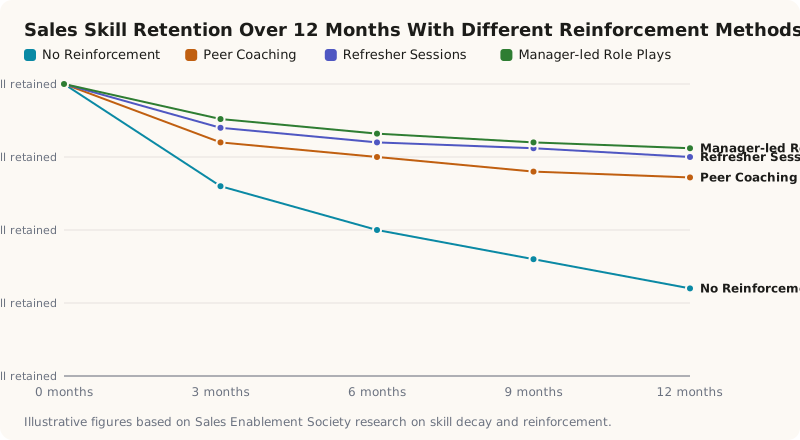
Research from the Sales Enablement Society and others confirms skills decay rapidly without coaching follow-ups. Effective ROI measurement accounts for ongoing reinforcement mechanisms—whether peer coaching, refresher sessions, or manager-led role plays—that sustain behavioral change.
8. Measuring Trainer Activity, Not Learner Outcomes
Tracking metrics like number of training hours delivered or sessions completed is easier than measuring actual learner behavior shifts or business impact. But these input-focused metrics don’t correlate reliably with ROI. Instead, focus on outcome-based measures like conversion rates pre- and post-training within your CRM.
9. Waiting Too Long or Too Short to Evaluate Impact
Effective ROI measurement depends on timing. Measuring sales training effectiveness too soon risks missing behavior changes that take weeks to emerge; waiting too long obscures causality as other factors intervene. A balanced, staged evaluation timeline—say, immediate, 3 months, and 6 months—provides a clearer picture.
Conclusion: Applying Precision to Sales Training ROI
Measuring sales training ROI is a complex, ongoing process that demands discipline and a robust framework. Avoiding these nine mistakes helps leaders shift from vague anecdotes to data-driven decisions about investing in sales enablement.
| Common Mistake | Frequency of Occurrence | Impact on ROI Accuracy | Data-Driven Decision Confidence |
|---|---|---|---|
| Ignoring Post-Training Metrics | 65 | 30 | 40 |
| Lack of Clear KPIs | 72 | 45 | 35 |
| Relying on Anecdotes | 58 | 25 | 42 |
| No Baseline Measurement | 50 | 40 | 38 |
| Overlooking Impact of External Factors | 45 | 35 | 40 |
| Infrequent Data Collection | 55 | 30 | 45 |
| Failure to Align with Business Goals | 60 | 50 | 30 |
| Ignoring Behavioral Change | 48 | 28 | 43 |
| Not Integrating Feedback Loops | 52 | 33 | 39 |
Bonus practical tip: Use your CRM’s reporting features—for example, in Salesforce, create a report comparing opportunity conversion rates for reps trained versus those not yet trained. This concrete data bridges training actions to sales outcomes.
And remember, the best training programs include support beyond initial sessions, empowering teams to use CRM tools effectively and consistently. That’s when ROI moves from theory to reality.
Ready to Audit Your Pipeline?
Get a high-level Training Needs Assessment for your sales organization.
About Nabeel Khalid
Nabeel is the founder of Sales Bullseye. He has trained hundreds of B2B sales professionals across Pakistan and the United States in the Bullseye Method — a high-integrity, methodology-led approach to complex deal closure built on retention, not one-off workshops.