7 Mistakes Companies Make When Running Sales Coaching Without a Clear Deal Review Cadence

The Quick Take
A rep walks into the Monday forecast meeting with three “likely to close” opportunities. By Friday, two of them have slipped, the third was never real, and the manager has only a few hurried questions before moving on. That pattern is famil
A rep walks into the Monday forecast meeting with three “likely to close” opportunities. By Friday, two of them have slipped, the third was never real, and the manager has only a few hurried questions before moving on. That pattern is familiar in teams that say they do sales coaching, but don’t have a clear deal review cadence. The result is usually not a motivation problem; it’s a process problem.
| Stage | Monday forecast meeting | By Friday | What it signals |
|---|---|---|---|
| Opportunity A | Likely to close | Slipped | Forecast was too optimistic |
| Opportunity B | Likely to close | Slipped | Risk was not surfaced early |
| Opportunity C | Likely to close | Never real | Qualification was not challenged |
| Manager behavior | A few hurried questions | Meeting moved on | Coaching is reactive, not structured |
| Underlying issue | Looks like a motivation problem | Actually a process problem | No clear deal review cadence |
Across GTM teams, there’s a clear shift underway: coaching is moving from occasional ride-alongs and generic feedback to structured, inspection-based management. Buyers researching sales coaching should care about that shift because it changes what “good” looks like. The best teams are not asking managers to be therapists or cheerleaders. They are asking them to run repeatable deal reviews that surface risk early, test rep thinking, and tie next steps to real buying signals.
Research and practitioner frameworks point in the same direction. Mike Weinberg’s emphasis on pipeline discipline, the MEDDICC qualification framework, and Challenger-style insight selling all rely on the same principle: if the deal is vague, coaching is vague. The conversation improves when managers inspect evidence — decision process, pain, metrics, stakeholders — instead of asking for optimism.
| Coaching focus | What managers ask | Coaching quality when evidence is present | Coaching quality when deal is vague |
|---|---|---|---|
| Pipeline discipline (Mike Weinberg) | What is the next concrete action and proof of progress? | Specific, corrective, and accountable | Generalized, reactive, and optimistic |
| MEDDICC qualification | What is the pain, metrics impact, decision process, and stakeholders? | Structured and diagnostic | Surface-level and assumption-based |
| Challenger-style insight selling | What insight changes the buyer’s view of the problem? | Strategic and evidence-led | Feature talk and hopeful messaging |
| Deal review cadence | What documented evidence supports the forecast? | Clear forecast hygiene and coaching priorities | Forecast ambiguity and weak coaching direction |
1. Treating coaching as an event instead of a cadence
One-off coaching sessions feel productive. They are also easy to forget. Without a deal review cadence, managers only see the loudest deals, usually the ones already in trouble. Consistent reviews create a rhythm where every meaningful opportunity gets pressure-tested at the same stage, not just when someone panics.
2. Reviewing the rep, not the deal
One of the most common sales coaching mistakes is turning the meeting into a performance conversation. “Why didn’t you push harder?” is not a deal review. Better questions: What changed in the buyer’s process? Who is missing? What evidence do we have for timeline and budget?
3. Using a generic checklist for every opportunity
Not every deal needs the same depth. A small expansion deal and a new enterprise logo should not be reviewed identically. Strong sales manager coaching adapts the questions to deal size, complexity, and stage. The structure stays consistent; the depth changes.
| Deal type | Typical value | Complexity | Stage | Recommended review depth | Example coaching focus |
|---|---|---|---|---|---|
| Small expansion | $5K–$25K | Low | Late stage | Light | Confirm business reason, timeline, and next step |
| Mid-market new business | $25K–$100K | Medium | Mid to late stage | Standard | Validate stakeholders, competition, and close plan |
| Enterprise new logo | $100K+ | High | Early to late stage | Deep | Probe multithreading, risk, procurement, and executive alignment |
4. Letting CRM data substitute for judgment
CRM fields are useful, but they are not a strategy. A deal can look clean in Salesforce or HubSpot and still be weak. Coaching should challenge the narrative behind the data: Why is the next step believable? What evidence supports it? Who is actually moving the buying process?
5. Focusing on late-stage deals only
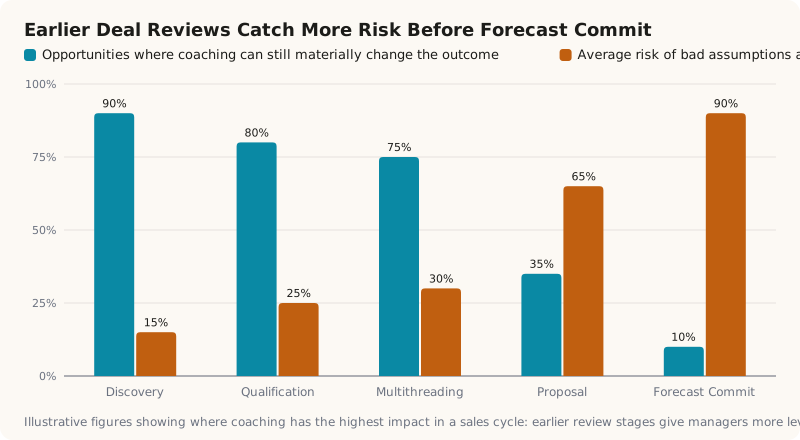
If coaching starts at proposal stage, it is already too late. The biggest payoff comes earlier, when managers can still shape discovery, multithreading, and qualification. That is where a clear review cadence helps most: it catches bad assumptions before they harden into forecast commits.
6. Making managers the sole source of insight
Good coaching is not about the manager having all the answers. It is about creating a better thinking process for the rep. Teams that do this well build shared language around buyer pain, decision criteria, and next-step validation. Without that, every manager invents their own style, and reps get mixed signals.
7. Confusing visibility with progress
A pipeline full of updates is not the same as a pipeline full of movement. If the only output of coaching is more CRM activity, the team may be busy without becoming sharper. The real benefit of a disciplined deal review cadence is simple: it shortens the time between a risk appearing and a manager addressing it.
How to build a simple deal review cadence in HubSpot CRM
If you are using HubSpot, one practical way to support coaching is to create a saved deals view for managers to review weekly.
| Deal stage | Deal count | Avg. next step due in 7 days | Primary coaching focus |
|---|---|---|---|
| Discovery | 12 | 9 | Qualification quality |
| Proposal | 8 | 6 | Value clarity and stakeholder mapping |
| Negotiation | 5 | 4 | Objection handling and close plan |
| Stalled / No recent activity | 7 | 7 | Re-engagement and next action |
| At risk / Past close date | 4 | 4 | Deal rescue and forecast accuracy |
- Log in to HubSpot and click CRM in the top navigation.
- Select Deals.
- Click the View dropdown near the top left of the deals table.
- Choose Create new view.
- Name the view something like Weekly Deal Review.
- Set filters such as Deal stage, Close date is this week, or Deal owner so the view shows the opportunities you want to inspect.
- Click Save view.
- Each week, open that saved view and use it as the agenda for your review meeting.
- For each deal, click the deal name and check the Activity and Notes tabs before the meeting so coaching is based on evidence, not memory.
That kind of setup is useful, but the tool only works as well as the coaching behind it. Proper sales coaching helps managers ask better questions, use the CRM consistently, and turn review meetings into decisions instead of status updates.
Ready to Audit Your Pipeline?
Get a high-level Training Needs Assessment for your sales organization.
About Nabeel Khalid
Nabeel is the founder of Sales Bullseye. He has trained hundreds of B2B sales professionals across Pakistan and the United States in the Bullseye Method — a high-integrity, methodology-led approach to complex deal closure built on retention, not one-off workshops.