6 Common Mistakes Companies Make When Implementing Sales Training Programs

The Quick Take
Imagine rolling out a sales training initiative your CEO championed — only to find that after months, your team's win rates and pipeline velocity are barely budging. There's a growing recognition in the sales enablement industry that simply
6 Common Mistakes Companies Make When Implementing Sales Training Programs
Imagine rolling out a sales training initiative your CEO championed — only to find that after months, your team's win rates and pipeline velocity are barely budging. There's a growing recognition in the sales enablement industry that simply 'checking the box' on training isn’t enough. But what traps are organizations falling into, and how can these sales training mistakes drain budgets and dampen morale?
Effective sales training is not a one-time event; it is a behavior-change system. The most common implementation failures happen when companies treat training as content delivery instead of a process that must be reinforced, measured, and tied to the way reps actually sell. That is why the difference between a program that “looks complete” and one that actually changes performance usually comes down to design discipline.
Common Sales Training Mistakes: Impact and Corrective Actions
| Mistake | Typical Impact on Sales Performance | Recommended Corrective Action |
|---|---|---|
| Launching Training Without Tailoring to Your Sales Process | -12% | Map training content to each stage of your documented sales process and buyer personas; customize role‑plays and examples |
| Neglecting Reinforcement and Coaching Post-Training | -18% | Institute a 90‑day reinforcement plan with weekly coaching, call reviews, and micro‑learning refreshers |
| Ignoring the Role of CRM Tools in Training Adoption | -20% | Embed CRM workflow steps into training, require reps to update pipeline stages in real time, and audit compliance |
| Overloading Reps with Too Much Content at Once | -25% | Break training into bite‑sized modules spaced over weeks, focusing on one skill per session |
| Failing to Measure Training Effectiveness Beyond Completion Rates | -30% | Define leading indicators (e.g., call quality scores, pipeline velocity) and lagging metrics (win rate, quota attainment) and track pre/post |
| Not Aligning Incentives with Desired Behaviors | -22% | Tie bonuses or SPIFs to adoption metrics (e.g., CRM field completion, use of new talk tracks) and reward improvement |
Illustrative figures
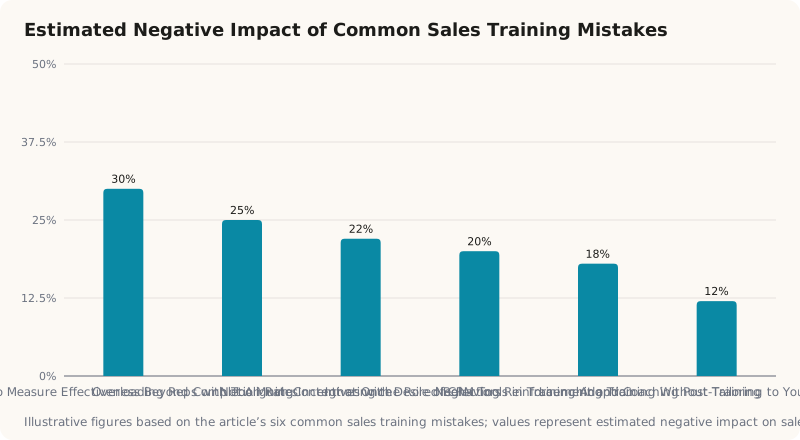 Illustrative figures based on the article’s six common sales training mistakes; values represent estimated negative impact on sales performance and are intended for visual comparison.
1. Launching Training Without Tailoring to Your Sales Process
A common pitfall is adopting generic sales training content that doesn’t reflect your company’s unique selling approach. Research by the Sales Management Association shows that sales enablement tailored to specific buyer personas and sales stages significantly outperforms off‑the‑shelf programs. When training isn’t integrated with your documented sales process, reps struggle to apply learned techniques, leading to eroded confidence and inconsistent customer conversations.
To make this actionable, define which behaviors must change at each stage of the funnel. For example, discovery training should include qualifying questions, call objectives, and objection handling for that stage — not a generic “how to sell better” message. The closer the module maps to daily execution, the faster adoption improves.
2. Neglecting Reinforcement and Coaching Post-Training
Implementing sales training often ends with a workshop or e‑learning module, but neglecting the critical follow‑up stage is a top sales program error. Behavioral science shows skills fade quickly without reinforcement. Practical application through ongoing coaching sessions, call reviews, or role plays cements new habits. Without these, reps revert to old behaviors, wasting your training investment.
A strong reinforcement cadence usually includes manager-led coaching, short practice sessions, and reminders inside the tools reps already use. The goal is to make the new behavior visible often enough that it becomes the default response in live deals.
3. Ignoring the Role of CRM Tools in Training Adoption
One overlooked mistake is failing to link sales training with CRM usage effectively. For example, using Salesforce without integrating training on managing pipeline stages or updating opportunity fields leads to poor data quality and limited leadership visibility. For reps, confusion about CRM expectations creates friction. Ensuring training covers concrete, actionable steps within your CRM—and includes follow‑ups—maximizes both tool adoption and sales effectiveness.
CRM adoption improves when training is embedded into actual workflow rather than discussed abstractly. That means showing reps exactly which fields matter, what “good data” looks like, and how those fields support forecasting, manager coaching, and prioritization.
4. Setting Unrealistic Expectations for Immediate Results
Sales leaders often expect rapid boosts in quota attainment after training. Yet, according to CSO Insights research, typical performance improvements emerge over several quarters as new behaviors mature. If leadership treats training as a silver bullet, lack of early wins leads to disappointment and premature program cutbacks. A realistic timeline with clear milestones helps align expectations and secures ongoing support.
Instead of judging success too early, track leading indicators first: completion of practice exercises, talk track adoption, CRM data quality, and manager coaching frequency. Those indicators usually move before revenue metrics do, and they tell you whether the program is actually taking hold.
5. Overlooking Segmentation of Training by Role and Experience
Another mistake is delivering a one‑size‑fits‑all curriculum to a diverse sales team. Entry‑level reps need different skills and pacing compared to seasoned account executives or sales managers. Failing to segment training content reduces relevance, engagement, and value. Customized learning paths aligned to role‑specific competencies drive better skill uptake and higher ROI.
Segmentation should be practical, not theoretical. New hires may need fundamentals and product knowledge, while experienced reps benefit more from advanced deal strategy, multi-threading, and negotiation practice. Managers need coaching skills, not just selling skills.
6. Not Measuring Training Impact Against Clear KPIs
Without quantifiable metrics, it’s hard to diagnose what’s working or missing in your sales training. Many companies overlook setting baseline performance indicators or tracking changes in win rates, deal size, or sales cycle length. Leveraging CRM and sales analytics to monitor these KPIs enables continuous improvement and justifies ongoing investment in training initiatives.
A simple measurement model connects training outputs to business outcomes. For example: training completion, practice quality, manager coaching activity, and CRM adoption are all inputs; pipeline progression, conversion rates, and win rate are the results. That chain makes the ROI conversation much easier with leadership.
Why Getting Sales Training Right Matters More Than Ever
The shift toward remote selling and buyer empowerment means your sales team’s skills and discipline must be sharper and more adaptable. Well‑structured sales training programs that avoid these common mistakes empower reps to navigate complex buyer journeys and outperform competitors. Choosing the right mix of custom content, ongoing coaching, CRM integration, and performance metrics creates tangible impact beyond initial sessions.
In practical terms, better implementation reduces wasted manager time, improves pipeline hygiene, and creates a more consistent customer experience. Those are the operational wins that make training feel less like an HR event and more like a sales performance lever.
How to Avoid These Pitfalls: Applying Practical Salesforce CRM Training
Consider the practical example of improving Salesforce adoption as part of your sales training. Training should include step‑by‑step guidance, such as how to add new leads accurately:
- Log into Salesforce and click the “Leads” tab in the top navigation.
- Click the green “New” button on the top right.
- Complete the lead’s information fields: Full Name, Company, Phone, Email, and Lead Source.
- Use drop‑downs to select lead status (e.g., “Open – Not Contacted”).
- Save the lead by clicking the “Save” button at the bottom.
Providing clear, CRM‑specific task training like this, followed by coaching reviews, ensures reps not only understand how to operate the tool but also appreciate its role in tracking sales activity and improving forecasting accuracy. This connection between training content and actual daily tasks drives behavior change.
Conclusion
Sales training mistakes—from generic content to lack of reinforcement and poor CRM integration—can weaken your go‑to‑market engine. Careful planning, role‑tailored programs, realistic expectations, and outcome measurement distinguish high‑impact initiatives. As you evaluate sales training providers, scrutinize how they help you avoid these pitfalls and embed new skills into your team’s workflows for sustained sales success.
Ready to Audit Your Pipeline?
Get a high-level Training Needs Assessment for your sales organization.
About Nabeel Khalid
Nabeel is the founder of Sales Bullseye. He has trained hundreds of B2B sales professionals across Pakistan and the United States in the Bullseye Method — a high-integrity, methodology-led approach to complex deal closure built on retention, not one-off workshops.