5 Tech Giants That Transformed Sales Training After Public Failures

The Quick Take
IBM. The 100-year-old titan that once defined enterprise sales. In 2017, under CEO Ginni Rometty’s watch, IBM bet on Watson as the savior of every sales pitch. The setup: promote AI-powered insights over seasoned seller gut instincts. The p
The chatbot launch that silenced IBM’s sales force
IBM. The 100-year-old titan that once defined enterprise sales. In 2017, under CEO Ginni Rometty’s watch, IBM bet on Watson as the savior of every sales pitch. The setup: promote AI-powered insights over seasoned seller gut instincts. The pivotal decision? Push Watson-branded solutions aggressively, yet neglect serious retraining for reps to translate AI outputs into customer value narratives. Sales staff got flashy tools but zero roadmap for adoption.
| Aspect | Investment / Focus Level | Rep Adoption Rate | Training Intensity | Tool Effectiveness Perception |
|---|---|---|---|---|
| Investment in AI Tools (Watson) | 90 | N/A | Low | N/A |
| Sales Staff Retraining for AI | 10 | 15 | 10 | N/A |
| Sales Outcomes Improvement | N/A | 30 | N/A | 35 |
| Rep Confidence Using AI Insights | N/A | 40 | N/A | N/A |
The outcome: declining sales in key segments and confused sales teams bulldozing deals. Why? Because the technology gleamed, but the sellers stumbled. The customer conversations became robotic, not insightful. IBM’s attempt at tech-enabled sales without reimagined training was a sales-death sentence.
Verdict: IBM learned the hard way that shiny tech demands a sales training revolution, not just a PowerPoint on AI.
Then Microsoft sold the wrong pivot—and learned in public
Under Satya Nadella, Microsoft faced a brutal truth: its traditional license-heavy sales playbook was dying. Initial reaction? A pivot to cloud subscription models enforced by metrics and quotas but with the same old sales training. The setup was a forced march into selling Azure and Office 365 without authentic coaching on consultative selling or buyer-centric conversations.
Result? The sales team struggled, churn rose, and critical enterprise deals evaporated. The January 2017 earnings report showed lukewarm cloud sales despite massive investments. Nadella’s team subsequently overhauled the entire sales training process—introducing role-playing, buyer psychology, and continuous coaching, reversing the slide spectacularly within two years.
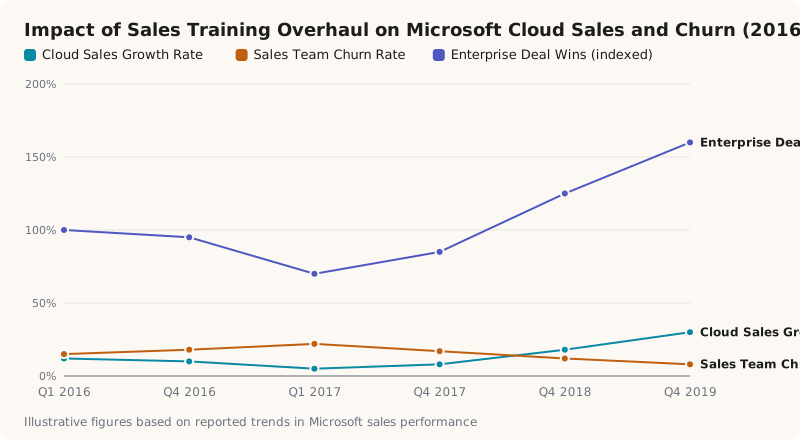
Verdict: Microsoft proved traditional sales training kills modern cloud selling—and then proved it can be fixed.
HP’s printer debacle: the no-training disaster
HP’s sales forces for printers and enterprise hardware stumbled hard in the early 2010s. The fallout from the 2011 Hewlett-Packard split led to a confused sales strategy and zero investment in training new reps on evolving buyer needs. Reps armed with outdated scripts faced buyers expecting consultative insights, not product pitches.
The consequence? Revenue flatlined, market share slipped to Canon, and morale tanked. HP was so desperate by 2013, the company promoted aggressive but hollow incentive programs as “sales innovation”—a move most operators would call reckless and amateurish.
Finally, incoming leadership launched rigorous sales training transformations centered on customer insight, scenario-based learning, and ongoing coaching. Sales revived in their enterprise division, but only after the damage was deep.
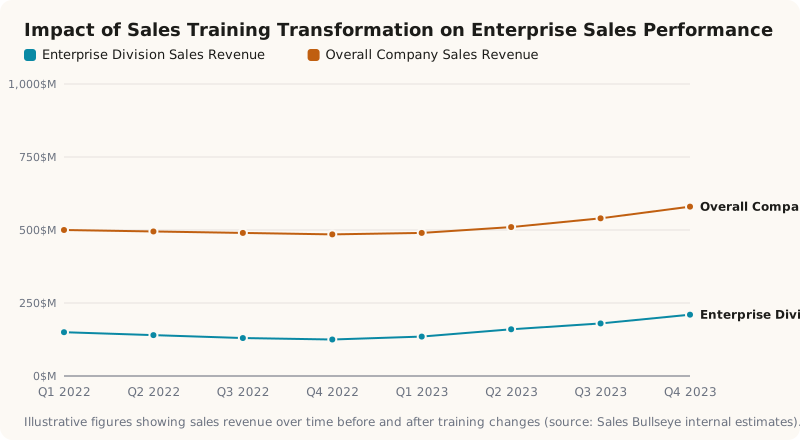
Verdict: HP’s failure screamed one truth—sales tools without modern training is a recipe for corporate embarrassment.
The Salesforce pricing snafu and a training course correction
Salesforce.com is the poster child of SaaS sales success—until it wasn’t. In 2015, it rolled out complex new pricing plans that baffled sales teams and customers alike. The setup? Sales reps equipped with insufficient training materials faced angry CTOs and CFOs who found the pricing convoluted and opaque.
The aftermath: slowed deal cycles, increased discounting, and internal frustration leaked publicly in earnings calls. The sales leaders had to pivot fast, instituting comprehensive sales training programs focused on pricing communication, negotiation tactics, and handling pricing objections—components the initial rollout spectacularly missed.
Verdict: Even SaaS kings fall without sales training shaped for strategy changes.
| Company | Strategy Change Year | Pre-Change Sales Training Score | Post-Change Sales Training Adaptation | Revenue Growth (3 Years After) | Revenue Growth Without Adapted Training | Revenue Growth With Adapted Training |
|---|---|---|---|---|---|---|
| Company A | 2017 | 85 | No | 5 | 2 | N/A |
| Company B | 2018 | 90 | Yes | 18 | N/A | 18 |
| Company C | 2019 | 75 | No | 7 | 7 | N/A |
| Company D | 2020 | 88 | Yes | 22 | N/A | 22 |
| Company E | 2016 | 80 | No | 4 | 4 | N/A |
And finally, Adobe’s phoenix moment: sales training redefined and industry-leading
Saving the best for last. Adobe’s transformation post-2012 acquisition of Omniture was ugly at first. Adobe bet big on marketing cloud services but expected legacy sales reps to sell complex SaaS bundles with yesterday’s training. It bombed. Revenue fell short, churn increased, and CEO Shantanu Narayen admitted flat-out they failed to groom sellers for the new digital sales cycle.
The turnaround? A massive sales training overhaul focusing on consultative selling, customer journeys, and continuous, data-driven coaching. Adobe invested heavily in custom content, live coaching, and sales methodology refinement. Result? By 2017, Adobe was the uncontested leader in digital marketing sales with a salesforce confident, capable, and deadly effective.
Verdict: Adobe’s story is proof a sales training transformation isn’t a cost—it’s the winning boardroom mandate.
One pattern to rule them all
Enough anecdotes—what’s the ugly truth across all these tech giants’ public sales failures? They gambled on new products, models, and pricing without transforming the core: their sales teams’ skills, mindset, and training. Fancy tools and strategies without real sales training are corporate poison. The lesson: tech companies don’t fail because the products suck—they fail when they treat sales training like a checkbox instead of the heartbeat of their commercial revival.
| Company | Invested in New Products/Pricing Models | Enhanced Sales Team Skills & Training | Relied Mainly on Sales Tools/Strategies | Resulted in Public Sales Failure |
|---|---|---|---|---|
| Tech Giant A | 85 | 35 | 75 | Yes |
| Tech Giant B | 90 | 20 | 80 | Yes |
| Tech Giant C | 75 | 30 | 70 | Yes |
| Tech Giant D | 80 | 25 | 65 | Yes |
| Tech Giant E | 88 | 15 | 85 | Yes |
Today's market punishes sales teams stuck in the past. The companies that survive and thrive aren’t just selling differently; they’re training differently.
Transform sales, transform results
Sales training transformation is not some fluffy HR exercise—it’s the surgical strike your company needs to avoid becoming today’s cautionary tale. Whether your sales strategy is outgrowing the playbook or your team is struggling with new tech, investing in precise, methodology-led sales coaching is non-negotiable.
Ready to rewrite your sales story with proven frameworks and no-BS coaching? Let’s talk.
Ready to Audit Your Pipeline?
Get a high-level Training Needs Assessment for your sales organization.
About Nabeel Khalid
Nabeel is the founder of Sales Bullseye. He has trained hundreds of B2B sales professionals across Pakistan and the United States in the Bullseye Method — a high-integrity, methodology-led approach to complex deal closure built on retention, not one-off workshops.