5 Tangible Benefits of Structured Sales Training: Increased Win Rates and Faster Ramp Time

The Quick Take
Imagine a sales team wrestling with inconsistent results: some reps closing deals quickly, while others stall for months. The cost? Lost quota, frustrated leadership, and a pipeline that can’t be trusted. This uneven performance signals a d
5 Tangible Benefits of Structured Sales Training: Increased Win Rates and Faster Ramp Time
Imagine a sales team wrestling with inconsistent results: some reps closing deals quickly, while others stall for months. The cost? Lost quota, frustrated leadership, and a pipeline that can’t be trusted. This uneven performance signals a deeper issue than just individual effort — often, the root cause is a lack of structured, repeatable sales training.
| Metric | Unstructured Training | Structured Training |
|---|---|---|
| Average Win Rate | 32 | 48 |
| Average Time to First Close (months) | 4.5 | 2.8 |
| Quota Attainment Rate | 45 | 70 |
| Sales Pipeline Accuracy | 60 | 85 |
| Rep-to-Rep Performance Variance | 35 | 15 |
1. Accelerated Ramp Time for New Sales Reps
Sales teams face constant pressure to onboard new hires quickly without compromising on skill quality. According to findings by the Sales Management Association, companies with formal sales training programs reduce ramp time by as much as 30%. Structured training expedites mastery of your products, ideal customer profiles, and objection-handling techniques. It also integrates coaching on your CRM, sales stages, and workflows — critical for efficiency.
When reps learn with methodical coaching, they spend less time guessing and more time selling, shortening the time to full productivity.
2. Measurable Improvement in Sales Team Performance
Improving sales team performance is rarely accidental. Research from the TAS Group shows that teams following a consistent sales methodology outperform peers by a significant margin in both conversion rates and deal size. Structured training brings uniformity to messaging and qualification criteria — creating a shared language and expectations.
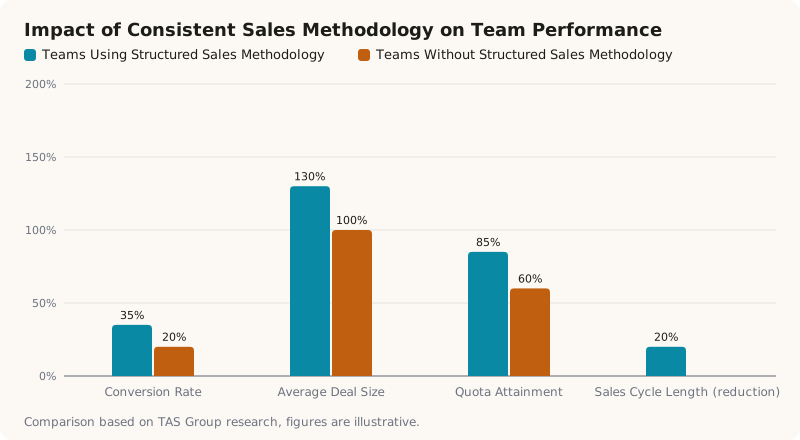
The benefit? Your sales team becomes a cohesive unit working toward clear, measurable goals rather than a series of disconnected individual performers.
3. Higher Win Rates Through Better Process Adoption
Win rates correlate closely with how rigorously reps apply a validated sales process. Training embeds this process, from discovery to closing, with practical frameworks emphasizing qualification and value demonstration rather than pitching features. Because it is methodology-led, training favors proven techniques over hype or intuition.
| Training Rigor Level | Average Win Rate | Average Ramp Time (Months) | Focus in Sales Process | Technique Emphasis |
|---|---|---|---|---|
| Low (Ad hoc process) | 25 | 6 | Feature pitching | Intuition-based |
| Moderate (Some process use) | 40 | 4.5 | Basic qualification | Mixed techniques |
| High (Consistent validated process) | 60 | 3 | Qualification & value demonstration | Methodology-led, proven techniques |
| Very High (Rigorously trained and coached) | 75 | 2 | Comprehensive discovery to close | Strict process adherence and frameworks |
This leads to a concrete increase in close ratios, since reps invest their time on opportunities assessed with rigorous criteria.
4. Lower Customer Acquisition Costs
Training reduces unnecessary effort and cycle time, which directly lowers the cost of acquiring each customer. Companies that lean on structured sales coaching report fewer wasted calls and meetings and better use of automation tools to nurture leads.
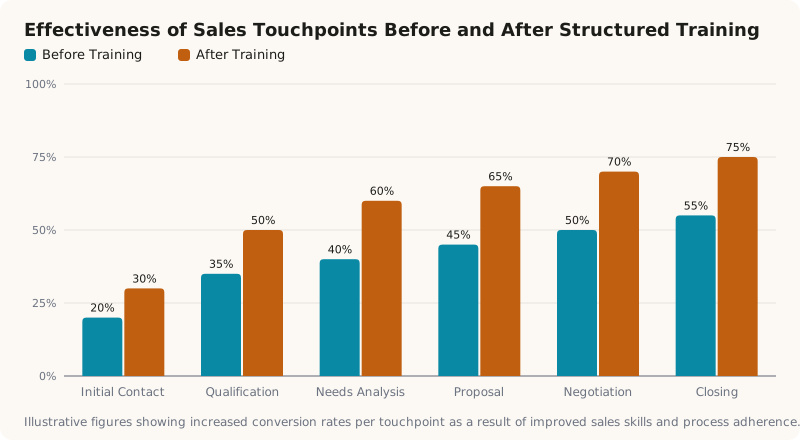
In effect, improved sales skills and process adherence make each touchpoint more effective, stretching your sales budget further without sacrificing output.
5. Stronger Adoption of Sales Technology
In many B2B sales organizations, customer relationship management (CRM) tools like Salesforce are underutilized or misused, limiting insight into pipeline health and forecasting accuracy. Structured training programs often include hands-on, role-specific modules on CRM use — from defining pipeline stages to running reports.
Practical Example: Setting Up a Sales Pipeline Stage in Salesforce
- Log into your Salesforce account and navigate to the Setup menu by clicking the gear icon in the upper-right corner.
- In the Quick Find box, type Sales Processes and select it under Feature Settings > Sales.
- Click New Sales Process to create a new pipeline or modify an existing process.
- Name your sales process (e.g., "New Business Pipeline") and select which opportunity stages to include.
- Save the sales process.
- Then, go back to Setup and type Opportunity Stages in Quick Find.
- Edit or add new stages that reflect your sales cycle, specifying name, probability percentage, and sort order.
- Apply your sales process to the appropriate record types so that reps see consistent pipeline stages when managing opportunities.
Without training, sales teams often struggle to maintain pipeline hygiene and trust data — making forecasting guesswork. Training helps ensure teams not only know how to perform these tasks but understand the why, increasing adoption and accuracy.
| Metric | Without Training | With Training | Improvement |
|---|---|---|---|
| Pipeline Hygiene Score | 55 | 85 | +30 |
| Forecast Accuracy | 50 | 80 | +30 |
| Data Trust Level | 45 | 82 | +37 |
| Adoption Rate of CRM Practices | 40 | 88 | +48 |
Structured Sales Training vs. Self-Led Learning
Some organizations rely on informal, on-the-job learning or piecemeal internal resources. While lower cost upfront, this approach often leads to mixed messaging, extended ramp time, and fragmented customer experiences. In contrast, structured training delivers consistent skill development at scale — it’s a repeatable investment that pays off through improved sales team performance and shorter ramp time.
In sum, exploring sales training means considering an investment that moves beyond quick fixes. It creates a reliable foundation for predictable selling success, helping your team close more deals, faster, with clear data and fewer surprises.
Ready to Audit Your Pipeline?
Get a high-level Training Needs Assessment for your sales organization.
About Nabeel Khalid
Nabeel is the founder of Sales Bullseye. He has trained hundreds of B2B sales professionals across Pakistan and the United States in the Bullseye Method — a high-integrity, methodology-led approach to complex deal closure built on retention, not one-off workshops.